Characterization of Bila Tea as a Natural Antioxidant in Usada-Based Product Development
DOI:
https://doi.org/10.36733/medicamento.v12i2.13310Keywords:
antioxidant, Bila Tea, DPPH, GC-MS, Usada BaliAbstract
Background: Bila Tea is a Usada-based herbal preparation formulated from amla (Phyllanthus emblica L.) fruit powder and avocado (Persea americana Mill.) seed powder in a 1:1 ratio, each 2 g tea bag containing 1 g of each component; both materials are used empirically in Bali, amla as loloh or decoction for fever, cough, and intestinal complaints and avocado seed as an astringent for digestive complaints.
Objective: This study aimed to characterize its compound profile and evaluate its in vitro antioxidant activity.
Methods: Volatile constituents were identified by gas chromatography–mass spectrometry (GC-MS), antioxidant activity was measured using the DPPH radical scavenging assay, and total phenolic, flavonoid, and tannin contents were determined spectrophotometrically, each reported as mean ± SD of three replicates.
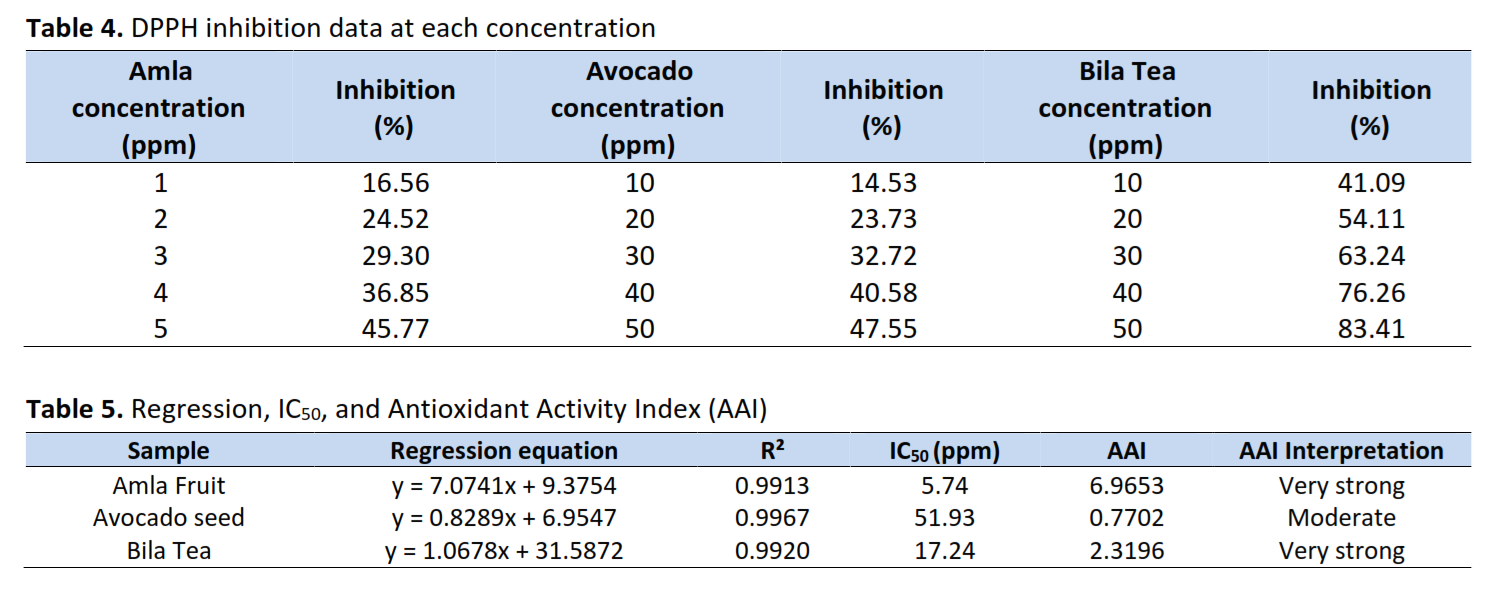
Results: GC-MS detected twelve compound peaks in the Bila Tea extract; the largest relative peak areas corresponded to gamma-gurjunene (23.875%), 1H-cycloprop(e)azulene (14.440%), and delta-guaiene (11.988%). IC50 values were 5.74 ppm for amla, 51.93 ppm for avocado seed, and 17.24 ppm for Bila Tea, corresponding to antioxidant activity indices (AAI) of 6.9653, 0.7702, and 2.3196, respectively. Bila Tea contained 2860.08 ± 0.27 mg GAE/100 g total phenolics, 354.47 ± 0.10 mg QE/100 g total flavonoids, and 18312.06 ± 6.50 mg TAE/100 g total tannins. These results indicate that Bila Tea exhibits very strong DPPH radical scavenging activity under the tested conditions. However, its activity was lower than that of amla alone and lower than the value predicted by dose additivity (combination index 1.67), providing no evidence of synergy between the two components.
Conclusion: The findings establish a preliminary chemical and antioxidant profile of Bila Tea; standardization, stability, safety, and in vivo evaluation remain necessary.
References
1. Mboi N, Syailendrawati R, Ostroff SM, et al. The state of health in Indonesia’s provinces, 1990–2019: a systematic analysis for the Global Burden of Disease Study 2019. Lancet Glob Health. 2022;10(11):e1632-e1645. doi:10.1016/S2214-109X(22)00371-0
2. Kurniawati, Ika Fitri, Sutoyo, Suyatno. Review Artikel: Potensi Bunga Tanaman Sukun (Artocarpus Altilis [Park. I] Fosberg) sebagai Bahan Antioksidan Alami [Article Review: The Potention of Breadfuit Flowers (Artocarpus altilis[Park. I] Fosberg) as Natural Antioxidant]. UNESA Journal of Chemistry. 2021;10(1). doi:10.26740/ujc.v10n1.p1-11
3. Munteanu IG, Apetrei C. Analytical Methods Used in Determining Antioxidant Activity: A Review. Int J Mol Sci. 2021;22(7):3380. doi:10.3390/ijms22073380
4. Arsana IN. Keragaman Tanaman Obat dalam Lontar Taru Pramana dan Pemanfaatannya untuk Pengobatan Tradisional Bali. Jurnal Kajian Bali. 2019;9(1):241-262. doi:10.24843/JKB.2019.v09.i01.p12%20
5. Andila PS, Tirta IG, Warseno T, Sutomo S. Medicinal Plants Diversity Used by Balinese in Buleleng Regency, Bali. J Trop Biodivers Biotechnol. 2023;8(1):73303. doi:10.22146/jtbb.73303
6. Pathak S, Pratap A, Sharma R, Jha MK. The Phyllanthus emblica Fruits: A Review on Phytochemistry Traditional Uses, Bioactive Composition and Pharmacological Activities. Curr Top Med Chem. 2024;24(22):1917-1939. doi:10.2174/0115680266321320240708060327
7. Huang H, Qiu M, Lin J, Li M, Ma X, Ran F, Luo C, Wei X, Xu R, Tan P, Fan S, Yang M, Han L & Zhang D. Potential effect of tropical fruits Phyllanthus emblica L. for the prevention and management of type 2 diabetic complications: a systematic review of recent advances. Eur J Nutr. 2021;60(7). doi:10.1007/s00394-020-02471-2
8. Cahyaningrum PL. Monograf Buah Amla (Phyllanthus emblica L.): Khasiat Antioksidan Dalam Sediaan Dekokta dan Loloh Ayurveda [Amla Fruit (Phyllanthus emblica L.) Monograph: Antioxidant Activity of Decoction and Ayurvedic Loloh Formulations]. Bandung: CV. Media Sains Indonesia; 2022.
9. Halim B, Syahputra R, Adenin I, et al. Determination of Phytochemical Constituent, Antioxidant Activity, Total Phenol and Total Flavonoid of Extract Ethanol Phyllanthus emblica Fruit. Pharmacognosy Journal. 2022;14(1):63-67. doi:10.5530/pj.2022.14.9
10. Ambarwati R, Rustiani E. Formulasi dan Evaluasi Nanopartikel Ekstrak Biji Alpukat (Persea americana Mill) dengan Polimer PLGA [Formulation and Characterization of Avocado Seed (Persea americana Mill.) Extract-Loaded PLGA Nanoparticles]. Majalah Farmasetika. 2022;7(4):305. doi:10.24198/mfarmasetika.v7i4.38549
11. Alim N, Hasan T, Rusman, Jasmiadi. Uji Aktivitas Antioksidan Ekstrak Biji Alpukat (Persea americana Mill.) Asal Enrekang Sulawesi Selatan dengan Metode DPPH [Antioxidant Activity of Avocado Seed (Persea americana Mill.) Extract from Enrekang, South Sulawesi, Evaluated Using the DPPH Assay]. Seminar Nasional Sains dan Terapan VI, 2022. https://ejournal.unsrat.ac.id/v3/index.php/sinta6/article/view/41885
12. Ajebli M, Khan H, Eddouks M. Natural Alkaloids and Diabetes Mellitus: A Review. Endocrine, Metabolic & Immune Disorders Drug Targets. 2021;21(1):111-130. doi:10.2174/1871530320666200821124817
13. Kurniawan K, Rahmat A. Determination of antioxidant activity, total phenolic, and total flavonoid contents from avocado seeds (Persea americana). IOP Conf Ser Earth Environ Sci. 2023;1201(1):012098. doi:10.1088/1755-1315/1201/1/012098
14. Onyedikachi UB, Nkwocha CC, Ejiofor E, Nnanna CC. Investigation of chemical constituents, antioxidant, anti-inflammatory and nutritional properties of oil of Persea americana (Avocado) seeds. Food Chemistry Advances. 2024;5:100770. doi:10.1016/j.focha.2024.100770
15. Essiedu JA, Gonu H, Adadi P, Withayagiat U. Polyphenols and Antioxidant Activity of Thunbergia laurifolia Infused Tea under Drying Conditions. J Food Qual. 2023;2023:1-9. doi:10.1155/2023/5046880
16. Jimenez P, Garcia P, Quitral V, et al. Pulp, Leaf, Peel and Seed of Avocado Fruit: A Review of Bioactive Compounds and Healthy Benefits. Food Reviews International. 2021;37(6):619-655. doi:10.1080/87559129.2020.1717520
17. Prananda AT, Dalimunthe A, Harahap U, et al. Phyllanthus emblica: a comprehensive review of its phytochemical composition and pharmacological properties. Front Pharmacol. 2023;14. doi:10.3389/fphar.2023.1288618
18. Alibi S, Crespo D, Navas J. Plant-Derivatives Small Molecules with Antibacterial Activity. Antibiotics. 2021;10(3):231. doi:10.3390/antibiotics10030231
19. Asmilia N, Fahrimal Y, Abrar M, Rinidar R. Chemical compounds of malacca leaf (Phyllanthus emblica) after triple extraction with n-hexane, ethyl acetate, and ethanol. Sci World J. Published online 2020:1-5. doi:10.1155/2020/2739056
20. Hotmian E, Suoth E, Fatimawali F, Tallei T. GC-MS (Gas Chromatography-Mass Spectrometry) Analysis of Nut Grass Tuber (Cyperus rotundus L.) Methanolic Extract. PHARMACON. 2021;10(2):849. doi:10.35799/pha.10.2021.34034
21. Nazaruddin N, Rosmaidar R, Siregar TN, Wahyuni S, Sutriana A. Phytocomponents analysis and antioxidant activity of Malacca fruit extract (Phyllanthus emblica) using three different solvents. Biodiversitas. 2024;25(5). doi:10.13057/biodiv/d250507
22. Widhiantara IG, Putra IMWA, Lestari NKD, Wiradana PA, Permatasari AAAP, Sari NKY, Windarista NPL, Elizabeth G, Sucipto TH. Ethnopharmacological study of medicinal plants used on usadha rare remedies in Bali Province, Indonesia. Biodiversitas. 2024;25(12). doi:10.13057/biodiv/d251208
23. Scherer R, Godoy HT. Antioxidant activity index (AAI) by the 2,2-diphenyl-1-picrylhydrazyl method. Food Chem. 2009;112(3):654-658. doi:10.1016/j.foodchem.2008.06.026
24. Yamauchi M, Kitamura Y, Nagano H, Kawatsu J, Gotoh H. DPPH Measurements and Structure—Activity Relationship Studies on the Antioxidant Capacity of Phenols. Antioxidants. 2024;13(3):309. doi:10.3390/antiox13030309
25. Singleton VL, Orthofer R, Lamuela-Raventós RM. [14] Analysis of total phenols and other oxidation substrates and antioxidants by means of folin-ciocalteu reagent. In: 1999:152-178. doi:10.1016/S0076-6879(99)99017-1
26. Chang CC, Yang MH, Wen HM, Chern JC. Estimation of total flavonoid content in propolis by two complementary colometric methods. J Food Drug Anal. 2020;10(3). doi:10.38212/2224-6614.2748
27. Makkar HPS. Quantification of Tannins in Tree and Shrub Foliage. Springer Netherlands; 2003. doi:10.1007/978-94-017-0273-7
28. Miramontes-Corona C, Torres-Santiago G, Rodriguez MMJ, Corona-González RI, Toriz G. Phenolic profile, antioxidant activity and antimicrobial properties of avocado (Persea americana) seed extracts. Chemical Papers. 2024;78(8):5061-5069. doi:10.1007/s11696-024-03452-z
29. Galano A, Raúl Alvarez‐Idaboy J. Computational strategies for predicting free radical scavengers’ protection against oxidative stress: Where are we and what might follow? Int J Quantum Chem. 2019;119(2). doi:10.1002/qua.25665
30. Shaker LM, Al-Amiery AA, Abed TK, et al. An overview of the density functional theory on antioxidant bioactivity predictive feasibilities: Insights from natural antioxidant products. J Mol Struct. 2024;1301:137393. doi:10.1016/j.molstruc.2023.137393
Downloads
Submitted
Accepted
Published
How to Cite
Issue
Section
License
Copyright (c) 2026 Putu Lakustini Cahyaningrum, Anak Agung Ayu Sauca Sunia Widyantari, Putut Dewantha Jenar, Ni Kadek Citra Lestari, I Kadek Tresna Adi Sentana

This work is licensed under a Creative Commons Attribution-NonCommercial-ShareAlike 4.0 International License.