Antifungal Activity of The Combination of Cinnamon Bark (Cinnamomum burmannii) and Turmeric Rhizome (Curcuma longa) Ethanolic Extracts against Candida albicans
DOI:
https://doi.org/10.36733/medicamento.v12i2.12917Keywords:
antifungal, Candida albicans, cinnamon, recurrent aphthous stomatitis, turmericAbstract
Background: Recurrent aphthous stomatitis is a common and painful multifactorial inflammatory condition of the oral mucosa, with a global prevalence of 20% and of 8% in Indonesia. The resulting open mucosal ulcerations facilitate opportunistic Candida albicans infection. The current increase in antifungal resistance of up to 40% has prompted research for alternative natural ingredients for safer and more effective treatments.
Objective: This study aimed to evaluate the antifungal activity of ethanolic extracts of cinnamon bark and turmeric, both individually and in combination, against C. albicans.
Methods: The extracts were obtained through a maceration method with 96% ethanol, and their phytochemical content was analyzed using LC-MS/MS. For the antifungal assay, the minimum inhibitory concentration (MIC) and minimum fungicidal concentration (MFC) values were determined using a microdilution test, while the effect of the extract combination was evaluated using a checkerboard microdilution method.
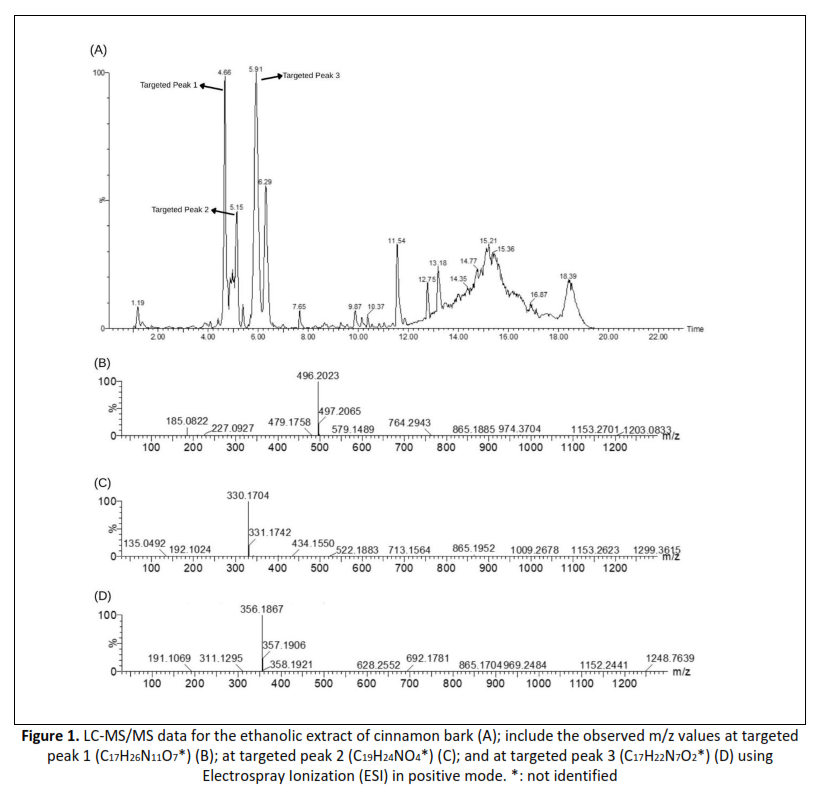
Results: LC-MS/MS analysis tentatively identified ar-turmerone, bisdemethoxycurcumin, and curcumin in turmeric extract, while cinnamon bark extract contained nitrogen-containing compounds. Turmeric extract showed stronger antifungal activity, with MIC and MFC values of 1,000 µg/mL, while cinnamon bark extract showed MIC and MFC values of 2,000 and >8,000 µg/mL, respectively. The combination of the two extracts led to a stronger inhibitory activity than each extract, resulting in an FICI of 0.14, indicating a synergistic effect.
Conclusions: These findings suggested that the combined treatment suppressed fungal growth at much lower concentrations, indicating a strong synergistic interaction between turmeric and cinnamon bark extracts with potential as a natural antifungal agent against C. albicans.
References
1. Chiang CP, Yu-Fong Chang J, Wang YP, Wu YH, Wu YC, Sun A. Recurrent Aphthous Stomatitis – Etiology, Serum Autoantibodies, Anemia, Hematinic Deficiencies, and Management. J Formos Med Assoc. 2019;118(9):1279-1289. doi:10.1016/j.jfma.2018.10.023
2. Ayun KQ, Adisasmita AC. Perbandingan Faktor Risiko Gangguan Kesehatan Gigi dan Mulut Pada Usia 20-59 Tahun Berdasarkan Wilayah di Indonesia: Analisis Survei Kesehatan Indonesia (SKI) Tahun 2023 [Comparison of Risk Factors for Dental and Oral Health Disorders Among Adults Aged 20-59 in Indonesia: Health Survey Analysis of Indonesia in 2023]. J Epidemiol Kesehat Indones. 2025;9(3):137-146. doi:10.7454/epidkes.v9i3.1154
3. Noujeim Z, Nasr L, Hajj R, El-Outa A. Prevalence of Recurrent Oral Ulcers and Association with ABO/Rh Group Systems in A Lebanese Sample. An Bras Dermatol. 2022;97(3):390-394. doi:10.1016/j.abd.2020.08.039
4. Mersil S, Alifia H. Antifungal Effectiveness Test of Cinnamon Extract (Cinnamomum burmannii) Against Candida albicans. Int J Med Sci Clin Res Stud. 2023;03(09):2013-2017. doi:10.47191/ijmscrs/v3-i9-39
5. Rizki SM, Panjaitan RS. Efektivitas Antifungi dari Minyak Atsiri Kulit Batang Kayu Manis (Cinnamomum burmanni) terhadap Candida albicans [Antifungal Activity of Cinnamon (Cinnamomum burmannii) Bark Essential Oil Against Candida albicans]. EduChemia (Jurnal Kim dan Pendidikan). 2018;3(2):172. doi:10.30870/educhemia.v3i2.4560
6. Rifasyah Z. Lexicon of Traditional Medicinal Plant in Deli Malay: An Ecolingustic Study. Tradit Mod Humanit. 2025;5(1):16-20. doi:10.32734/tmh.v5i1.21664
7. Wojtyłko M, Kunstman P, Bartylak H, Raszewski Ł, Osmałek T, Froelich A. A Well-Known Plant and New Therapeutic Strategies: Turmeric and Its Components in Oral Inflammatory Diseases Treatment. Appl Sci. 2023;13(13):7809. doi:10.3390/app13137809
8. Prasetyorini, Indah W. D, Yulianita, Novi FU, Rani N. Antimicrobial Activities Assessment of Cinnamon Bark (Cinnamomum burmannii Nees & T . Nees ) Extract against Caries Factors. Sci Technol Publ. 2022;1(1):494-501. doi:10.5220/0010205500002775
9. Djarot P, Yulianita, Utami NF, Putra AM, Putri YIM, Muhardianty SM, Suciyani TA, Syaepulrohman A. Bioactivities and Chemical Compositions of Cinnamomum burmannii Bark Extracts (Lauraceae). Sustain. 2023;15(2):1-15. doi:10.3390/su15021696
10. Mubarak Z, Gani BA, Mutia M. Daya Hambat Kunyit (Curcuma longa Linn.) terhadap Pertumbuhan Candida albicans [Inhibitory Effect of Turmeric (Curcuma longa L.) on the Growth of Candida albicans]. Cakradonya Dent J. 2023;11(1):1-7. doi:10.24815/cdj.v11i1.13621
11. Suprihatin T, Rahayu S, Rifa’i M, Widyarti S. Senyawa pada Serbuk Rimpang Kunyit (Curcuma longa L.) yang Berpotensi sebagai Antioksidan [Compounds with Antioxidant Potential in Turmeric (Curcuma longa L.) Rhizome Powder]. Bul Anat dan Fisiol. 2020;5(1):35-42. doi:10.14710/baf.5.1.2020.35-42
12. Yuditha S, Rafana AE, Kusparmanto L. Potential Inhibitory Power of “Curcuma longa Linn.” Extract Against Candida albicans Fungus. Moestopo Int Rev Soc Humanit Sci. 2022;2(2):120-126. doi:10.32509/mirshus.v2i2.39
13. Lee YS, Chen X, Widiyanto TW, Orihara K, Shibata H, Kajiwara S. Curcumin Affects Function of Hsp90 and Drug Efflux Pump of Candida albicans. Front Cell Infect Microbiol. 2022;12(September):1-17. doi:10.3389/fcimb.2022.944611
14. Kumari A, Raina N, Wahi A, Goh KW, Sharma P, Nagpal R, Jain A, Ming LC, Gupta M. Wound-Healing Effects of Curcumin and Its Nanoformulations: A Comprehensive Review. Pharmaceutics. 2022;14(11):2288. doi:10.3390/pharmaceutics14112288
15. Costa RA, Ortega DB, Fulgêncio DLA, Costa FS, Araújo TF, Barreto CC. Checkerboard Testing Method Indicates Synergic Effect of Pelgipeptins against Multidrug Resistant Klebsiella pneumoniae. Biotechnol Res Innov. 2019;3(1):187-191. doi:10.1016/j.biori.2018.12.001
16. Kementerian Kesehatan Republik Indonesia. Farmakope Herbal Indonesia Edisi II 2017 [Indonesian Herbal Pharmacopoeia, 2nd Edition, 2017]. 2nd ed. Kementerian Kesehatan Republik Indonesia; 2017.
17. Basavaraja D, Katkar R, Dhaka P, Tomar S, Sircar D, Chikara G, Panda PK. Chemical Analysis of Native Himalayan Shilajit: An Evaluation of an Ayurvedic Formulation. ACS Omega. 2025;10(47):57097-57106. doi:10.1021/acsomega.5c05533
18. Wibowo FB, Tutik T, Amalia P. Standarisasi Mutu Simplisia Kulit Bawang Merah (Allium cepa L.) [Pharmacognostic Quality Standardization of Red Onion (Allium cepa L.) Peels]. J Anal Farm. 2024;9(2):163-172. doi:10.33024/jaf.v9i2.11857
19. Velázquez-Martínez V, Valles-Rosales D, Rodríguez-Uribe L, Laguna-Camacho JR, López-Calderón HD, Delgado E. Effect of Different Extraction Methods and Geographical Origins on the Total Phenolic Yield, Composition, and Antimicrobial Activity of Sugarcane Bagasse Extracts. Front Nutr. 2022;9(February):1-10. doi:10.3389/fnut.2022.834557
20. Prakash A, Janmeda P, Pathak P, Bhatt S, Sharma V. Development and Standardization of Quality Control Parameters of Different Parts of Trianthema portulacastrum L. SN Appl Sci. 2019;1(9):1108. doi:10.1007/s42452-019-1074-3
21. Martha RD, Danar D, Safitri YD, Parbuntari H. Identifikasi Senyawa Flavonoid Daun Jinten (Plectranthus amboinicus) Menggunakan Liquid Chromatography-Mass Spectrometry (LC-MS) dan Potensinya sebagai Antikanker Secara In-Vitro [Identification of Flavonoid Compounds in Cumin Leaves (Plectranthus amboinicus) Using Liquid Chromatography-Mass Spectrometry (LC-MS) and Their Potential as Anticancer In-Vitro]. Sainteks. 2024;21(1):67. doi:10.30595/sainteks.v21i1.21171
22. Chang HS, Chen IS. Chemical Constituents and Bioactivity of Formosan lauraceous Plants. J Food Drug Anal. 2016;24(2):247-263. doi:10.1016/j.jfda.2015.10.008
23. Li HT, Li WJ, Wu HM, Chen CY. Alkaloids from Cinnamomum philippinense. Nat Prod Commun. 2012;7(12):1581-1582. doi:10.1177/1934578x1200701209
24. Nunes C, de J. Raposo MF, Petronilho S, Machado F, Fulgêncio R, Gomes MH, Evtuguin D V., Rocha SM, Coimbra MA. Cinnamomum burmannii Decoction: A Thickening and Flavouring Ingredient. Lwt-Food Sci Technol. 2022;153(1):1-10. doi:10.1016/j.lwt.2021.112428
25. Liu S ling, Yang K han, Yang C wei, Lee M yu, Chuang Y ting, Chen Y ning, Chang F rong, Chen C yi, Chang H wei. Burmannic Acid Inhibits Proliferation and Induces Oxidative Stress Response of Oral Cancer Cells. Antioxidants. 2021;10(1):1-15. doi:10.3390/antiox10101588
26. TL Y, HC Y, HT L, SL L, CY C. A New Tetrahydrofuran of Cinnamomum burmannii. Chem Pharm Res. 2023;5(1):1-5. doi:10.33425/2689-1050.1047
27. Farag MA, Khaled SE, El Gingeehy Z, Shamma SN, Zayed A. Comparative Metabolite Profiling and Fingerprinting of Medicinal Cinnamon Bark and Its Commercial Preparations via a Multiplex Approach of GC–MS, UV, and NMR Techniques. Metabolites. 2022;12(7):614. doi:10.3390/metabo12070614
28. Yu T, Yao H, Qi S, Wang J. GC-MS Analysis of Volatiles in Cinnamon Essential Oil Extracted by Different Methods. Grasas y Aceites. 2020;71(3):e372. doi:10.3989/gya.0462191
29. Burapan S, Kim M, Paisooksantivatana Y, Eser BE, Han J. Thai Curcuma Species: Antioxidant and Bioactive Compounds. Foods. 2020;9(9):1219. doi:10.3390/foods9091219
30. Luhurningtyas FP, Vifta RL, Khotimah SK. Uji Aktivitas Antijamur Ekstrak Biji Bligo (Benincasa hispida (Thunb.) Cogn.) terhadap Pertumbuhan Jamur Candida albicans [Antifungal Activity of Benincasa hispida (Thunb.) Cogn. Seed Extract Against the Growth of Candida albicans]. Indones J Pharm Nat Prod. 2018;1(1):30-35. doi:10.35473/ijpnp.v1i1.32
31. Sartoratto A, Machado ALM, Delarmelina C, Figueira GM, Duarte MCT, Rehder VLG. Composition and Antimicrobial Activity of Essential Oils from Aromatic Plants Used in Brazil. Brazilian J Microbiol. 2004;35(4):275-280. doi:10.1590/S1517-83822004000300001
32. Franconi I, Lupetti A. In Vitro Susceptibility Tests in the Context of Antifungal Resistance: Beyond Minimum Inhibitory Concentration in Candida spp. J Fungi. 2023;9(12):1-22. doi:10.3390/jof9121188
33. Bellio P, Fagnani L, Nazzicone L, Celenza G. New and Simplified Method for Drug Combination Studies by Checkerboard Assay. MethodsX. 2021;8(1):1-7. doi:10.1016/j.mex.2021.101543
34. Nikolic I, Vukovic D, Gavric D, Cvetanovic J, Aleksic Sabo V, Gostimirovic S, Narancic J, Knezevic P. An Optimized Checkerboard Method for Phage-Antibiotic Synergy Detection. Viruses. 2022;14(7):1-14. doi:10.3390/v14071542
35. Meccatti VM, Santos LF, de Carvalho LS, Souza CB, Carvalho CAT, Marcucci MC, Abu Hasna A, de Oliveira LD. Antifungal Action of Herbal Plants’ Glycolic Extracts against Candida Species. Molecules. 2023;28(6):2857. doi:10.3390/molecules28062857
36. Cho E. Synergistic Antifungal Effects of Botanical Extracts against Candida albicans. PLoS One. 2026;1(1):1-15. doi:10.1371/journal.pone.0340665
37. Tsopmene UJ, Kuate CRT, Kayoka-kabongo PN, Bisso BN, Metopa A, Mofor CT, Dzoyem JP. Antibiofilm Activity of Curcumin and Piperine and Their Synergistic Effects with Antifungals against Candida albicans Clinical Isolates. Scientifica (Cairo). 2024;1(1):1-10. doi:10.1155/2024/2025557
38. Shahina Z, Molaeitabari A, Sultana T, Dahms TES. Cinnamon Leaf and Clove Essential Oils are Potent Inhibitors of Candida albicans Virulence Traits. Microorganisms. 2022;10(10):1989. doi:10.3390/microorganisms10101989
39. Sitorus CJ, Hutabarat GAR. Uji Kandungan Alkaloid pada Bubuk Kayu Manis (Cinnamomum burmannii) dengan Metode Sokletasi [Analysis of Alkaloid Content in Cinnamon (Cinnamomum burmannii) Powder Using Soxhlet Extraction]. Konstanta J Mat dan Ilmu Pengetah Alam. 2024;2(2):180-187. doi:10.59581/konstanta.v2i2.3367
40. Cheraghipour K, Ezatpour B, Masoori L, Marzban A, Sepahvand A, Rouzbahani AK, Moridnia A, Khanizadeh S, Mahmoudvand H. Anti-Candida Activity of Curcumin: A Systematic Review. Curr Drug Discov Technol. 2020;16(3):379-390. doi:10.2174/1570163817666200518074629
Downloads
Submitted
Accepted
Published
How to Cite
Issue
Section
License
Copyright (c) 2026 Ni Komang Ayu Cintia Dewi, Andreas Gangsar Bayu Waskito, I Komang Yodi Premanadinata, Gusti Ayu Indah Pradnya Apsari Dewi, Dhea Amanda Avrillya, Anak Agung Ayu Vivi Trysbiantari Kusuma, Cokorda Istri Diah Ari Saci Prabandari Susila, Nonye Treasure Ujam, Ni Putu Eka Leliqia, Ni Putu Ariantari

This work is licensed under a Creative Commons Attribution-NonCommercial-ShareAlike 4.0 International License.