Neuroprotective Activity of Cassia fistula and Hibiscus sabdariffa Flos Combined Extracts on the Brain Cell Count of Stressed Male Mice
DOI:
https://doi.org/10.36733/medicamento.v12i2.13150Keywords:
Cassia fistula, chronic stress, Hibiscus sabdariffa Flos, hippocampus, neuroprotectiveAbstract
Background: Chronic stress induces excessive reactive oxygen species (ROS) production, leading to oxidative stress, neuroinflammation, and hippocampal neuronal degeneration. Natural products rich in antioxidant phytochemicals are potential neuroprotective agents. Cassia fistula and Hibiscus sabdariffa flowers contain bioactive compounds with antioxidant and anti-inflammatory properties; however, evidence regarding the neuroprotective effects of their combined extracts remains limited.
Objective: To evaluate the neuroprotective effects of combined Cassia fistula and Hibiscus sabdariffa flower extracts on hippocampal neuronal damage and normal neuronal cell counts in male mice exposed to chronic immobilization stress.
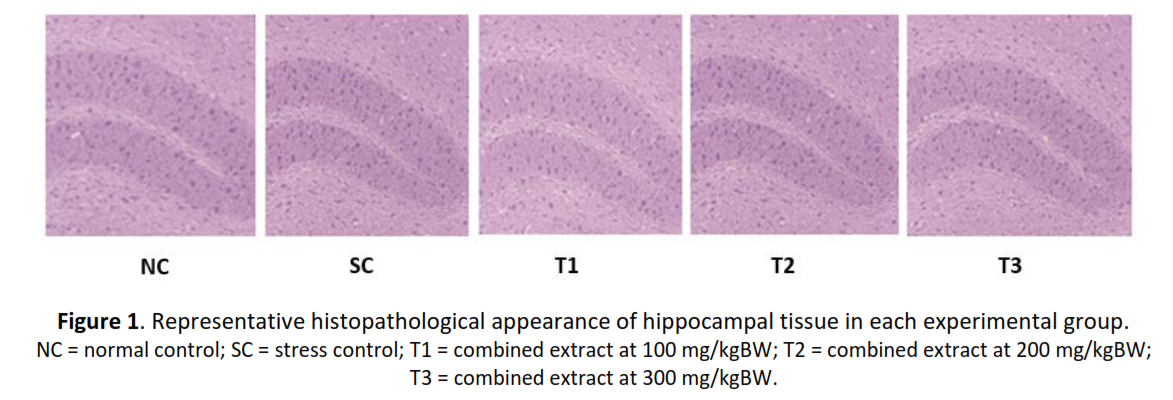
Methods: A laboratory experimental study with a Completely Randomized Design was conducted using 25 male Mus musculus randomly assigned to five groups (n = 5): a normal control, a stress control, and three treatment groups receiving combined extracts at doses of 100, 200, or 300 mg/kgBW. Stress was induced by immobilization for 2 h/day for 14 days, followed by extract administration for 35 days. Neuroprotective activity was evaluated histopathologically on hematoxylin and eosin-stained hippocampal sections by assessing neuronal damage and normal neuron counts. Data were analyzed using one-way ANOVA and Duncan's Multiple Range Test (p < 0.05).
Results: Chronic stress significantly increased hippocampal neuronal damage and reduced normal neuron counts. Combined extract treatment significantly reduced neuronal damage and increased normal hippocampal neurons in a dose-dependent manner (p < 0.05), with the 300 mg/kg group showing the greatest effect.
Conclusion: Combined Cassia fistula and Hibiscus sabdariffa flower extracts exerted dose-dependent neuroprotective effects against chronic stress-induced hippocampal injury in male mice, supporting their potential as natural neuroprotective agents and warranting further pharmacological and phytochemical studies.
References
1. Yaribeygi H, Panahi Y, Sahraei H, Johnston TP, Sahebkar A. The impact of stress on body function: A review. EXCLI J. 2017;16:1057-1072. doi:10.17179/excli2017-480
2. Knezevic E, Nenic K, Milanovic V, Knezevic NN. The role of cortisol in chronic stress, neurodegenerative diseases, and psychological disorders. Cells. 2023;12(23):2726. doi:10.3390/cells12232726
3. Almalki DF, Alkabkabi RA, Wayyani RA, et al. Chronic stress, cortisol dysregulation, and neurodegenerative vulnerability: Mechanistic pathways linking HPA-axis dysfunction to Alzheimer's disease risk. Front Aging Neurosci. 2026;18:1883880. doi:10.3389/fnagi.2026.1883880
4. de la Tremblaye PB, Raymond J, Milot MR, Merali Z, Plamondon H. Evidence of lasting dysregulation of neuroendocrine and hypothalamic-pituitary-adrenal axis function following global cerebral ischemia in male rats and the effect of antalarmin on plasma corticosterone levels. Horm Behav. 2014;65(3):273-284. doi:10.1016/j.yhbeh.2014.01.003
5. Park EH, Jo YS, Kim EJ, et al. Heterogenous effect of early adulthood stress on cognitive aging and synaptic function in the dentate gyrus. Front Mol Neurosci. 2024;17:1344141. doi:10.3389/fnmol.2024.1344141
6. Gulyaeva NV, Onufriev MV, Moiseeva YV. Ischemic stroke, glucocorticoids, and remote hippocampal damage: A translational outlook and implications for modeling. Front Neurosci. 2021;15:781964. doi:10.3389/fnins.2021.781964
7. Kang H, Shao T, Shi Y, et al. Chronic stress and cognitive dysfunction in myalgic encephalomyelitis/chronic fatigue syndrome: HPA axis dysregulation and hippocampal plasticity. Front Neurosci. 2026;20:1814098. doi:10.3389/fnins.2026.1814098
8. Pohl F, Kong Thoo Lin P. The potential use of plant natural products and plant extracts with antioxidant properties for the prevention and treatment of neurodegenerative diseases: In vitro, in vivo and clinical trials. Molecules. 2018;23(12):3283. doi:10.3390/molecules23123283
9. Marino A, Battaglini M, Moles N, Ciofani G. Natural antioxidant compounds as potential pharmaceutical tools against neurodegenerative diseases. ACS Omega. 2022;7(30):25974-25990. doi:10.1021/acsomega.2c03291
10. Shoaib S, Ansari MA, Fatease AA, et al. Plant-derived bioactive compounds in the management of neurodegenerative disorders: Challenges, future directions, and molecular mechanisms involved in neuroprotection. Pharmaceutics. 2023;15(3):749. doi:10.3390/pharmaceutics15030749
11. Mwangi RW, Macharia JM, Wagara IN, Bence RL. The medicinal properties of Cassia fistula L.: A review. Biomed Pharmacother. 2021;144:112240. doi:10.1016/j.biopha.2021.112240
12. Saeed M, Naseer S, Hussain S, Iqbal M. Phytochemical composition and pharmacological effects of Cassia fistula. Sci Inq Rev. 2020;4(1):59-69. doi:10.32350/sir.41.05
13. Harditya KB. Antioxidant activity, phenolic, and total flavonoid value of Balinese trengguli flower (Cassia fistula). J Pijar MIPA. 2024;19(1):113-118. doi:10.29303/jpm.v19i1.6222
14. El-Shiekh RA, Ashour RM, Abd El-Haleim EA, Ahmed KA, Abdel-Sattar E. Hibiscus sabdariffa L.: A potent natural neuroprotective agent for the prevention of streptozotocin-induced Alzheimer's disease in mice. Biomed Pharmacother. 2020;128:110303. doi:10.1016/j.biopha.2020.110303
15. Mishra MK, Wang J, Mirzaei R, et al. A distinct Hibiscus sabdariffa extract prevents iron neurotoxicity, a driver of multiple sclerosis pathology. Cells. 2022;11(3):440. doi:10.3390/cells11030440
16. Efosa JO, Omage K, Azeke MA. Hibiscus sabdariffa calyx protects against oxidative stress and aluminum chloride-induced neurotoxicity in the brain of experimental rats. Toxicol Rep. 2023;10:469-480. doi:10.1016/j.toxrep.2023.04.008
17. Percie du Sert N, Hurst V, Ahluwalia A, et al. The ARRIVE guidelines 2.0: Updated guidelines for reporting animal research. PLoS Biol. 2020;18(7):e3000410. doi:10.1371/journal.pbio.3000410
18. Percie du Sert N, Ahluwalia A, Alam S, et al. Reporting animal research: Explanation and elaboration for the ARRIVE guidelines 2.0. PLoS Biol. 2020;18(7):e3000411. doi:10.1371/journal.pbio.3000411
19. Ambari Y, Fitri S, Nurrosyidah IH. Uji aktivitas antioksidan masker gel peel-off ekstrak etanol kelopak bunga rosela (Hibiscus sabdariffa L.) dengan metode DPPH (1,1-diphenyl-2-picryhydrazyl) [Antioxidant Activity Test of Peel-off Mask Containing Roselle Calices Ethanol Extract using DPPH (1,1-Diphenyl-2-picryhydrazyl) Method]. PHARMACY (Pharmaceutical Journal of Indonesia). 2021;18(1):54-64. doi:10.30595/pharmacy.v18i1.8700
20. Erdoğan S. Determination of sample size using resource equation methods in analysis of variance models in animal studies. Dicle Univ Vet Fak Derg. 2024;17(1):1-7. doi:10.47027/duvetfd.1308466
21. Shomer NH, Allen-Worthington KH, Hickman DL, et al. Review of rodent euthanasia methods. J Am Assoc Lab Anim Sci. 2020;59(3):242-253. doi:10.30802/AALAS-JAALAS-19-000084
22. Lu J, Zhang Y, Pan X, et al. A brief interpretation of AVMA guidelines on euthanasia of animals: 2020 edition. Lab Anim Comp Med. 2021;41(3):195-200. doi:10.12300/j.issn.1674-5817.2021.086
23. Karp NA, Fry D. What is the optimum design for my animal experiment? BMJ Open Sci. 2021;5(1):e100126. doi:10.1136/bmjos-2020-100126
24. Woźny-Rasała I, Ogłodek EA. NLRP3 inflammasome in stress-related neuropsychiatric disorders: Mechanisms of neuron-microglia-astrocyte crosstalk, HPA axis dysregulation, and therapeutic perspective. Biomolecules. 2025;15(9):1344. doi:10.3390/biom15091344
25. Oyovwi MO, Chijiokwu EA, Ben-Azu B, et al. Potential roles of natural antioxidants in modulating neurodegenerative disease pathways. Mol Neurobiol. 2025;62:10367-10397. doi:10.1007/s12035-025-04874-w
26. Shalgum A, Govindarajulu M, Majrashi M, et al. Neuroprotective effects of Hibiscus sabdariffa against hydrogen peroxide-induced toxicity. J Herb Med. 2019;17:100253. doi:10.1016/j.hermed.2018.100253
27. Antonisamy P, Agastian P, Kang CW, Kim NS, Kim JH. Anti-inflammatory activity of rhein isolated from the flowers of Cassia fistula L. and possible underlying mechanisms. Saudi J Biol Sci. 2019;26(1):96-104. doi:10.1016/j.sjbs.2017.04.011
28. Kour R, Sharma N, Showkat S, et al. Methanolic fraction of Cassia fistula L. bark exhibits potential to combat oxidative stress and possesses antiproliferative activity. J Toxicol Environ Health A. 2023;86(9):296-312. doi:10.1080/15287394.2023.2189435
29. Kiran S, Shihab WA, Mahmood AAR, et al. Targeting neuroinflammation: Anti-Alzheimer's mechanism of Cassia fistula via in silico approaches. Indian J Biochem Biophys. 2026;63(3):321-340. doi:10.56042/ijbb.v63i3.20526
30. Ali T, Kim T, Rehman SU, et al. Natural dietary supplementation of anthocyanins via PI3K/Akt/Nrf2/HO-1 pathways mitigates oxidative stress, neurodegeneration, and memory impairment in a mouse model of Alzheimer's disease. Mol Neurobiol. 2018;55(7):6076-6093. doi:10.1007/s12035-017-0798-6
31. Morén C, deSouza RM, Giraldo DM, Uff C. Antioxidant therapeutic strategies in neurodegenerative diseases. Int J Mol Sci. 2022;23(16):9328. doi:10.3390/ijms23169328
32. Akbari B, Baghaei-Yazdi N, Bahmaie M, Mahdavi Abhari F. The role of plant-derived natural antioxidants in reduction of oxidative stress. Biofactors. 2022;48(3):611-633. doi:10.1002/biof.1831
33. Jalouli M, Rahman MA, Biswas P, et al. Targeting natural antioxidant polyphenols to protect against neuroinflammation and neurodegenerative diseases: A comprehensive review. Front Pharmacol. 2025;16:1492517. doi:10.3389/fphar.2025.1492517
34. Ramana KV, Reddy ABM, Majeti NVRK, Singhal SS. Therapeutic potential of natural antioxidants. Oxid Med Cell Longev. 2018;2018:9471051. doi:10.1155/2018/9471051
35. Guo Q, Li F, Duan Y, et al. Oxidative stress, nutritional antioxidants and beyond. Sci China Life Sci. 2020;63(6):866-874. doi:10.1007/s11427-019-9591-5
36. Sarkar B, Rana N, Singh C, et al. Medicinal herbal remedies in neurodegenerative diseases: An update on antioxidant potential. Naunyn Schmiedebergs Arch Pharmacol. 2024;397:5483-5511. doi:10.1007/s00210-024-03027-5
37. Singh R, Khanam H, Pandey J. The biological properties and medical importance of Cassia fistula: A mini review. Chem Proc. 2023;14(1):95. doi:10.3390/ecsoc-27-16149
38. Tavan M, Hanachi P, Cádiz-Gurrea ML, et al. Natural phenolic compounds with neuroprotective effects. Neurochem Res. 2024;49(2):306-326. doi:10.1007/s11064-023-04046-z
39. Souza LC, Antunes MS, Borges Filho C, et al. Flavonoid chrysin prevents age-related cognitive decline via attenuation of oxidative stress and modulation of BDNF levels in aged mouse brain. Pharmacol Biochem Behav. 2015;134:22-30. doi:10.1016/j.pbb.2015.04.010
Downloads
Submitted
Accepted
Published
How to Cite
Issue
Section
License
Copyright (c) 2026 Kadek Buja Harditya, Anak Agung Istri Mas Padmiswari

This work is licensed under a Creative Commons Attribution-NonCommercial-ShareAlike 4.0 International License.