Simultaneous Determination of Hydroquinone, Tretinoin, and Resorcinol in Cream Preparations Using the Spectrophotometry UV-Vis Development and Validation Method
DOI:
https://doi.org/10.36733/medicamento.v12i2.12477Keywords:
hydroquinone, resorcinol, tretinoin, UV-Vis spectrophotometry, validationAbstract
Background: Skin-whitening creams may contain undeclared or prohibited active ingredients, including hydroquinone, tretinoin, and resorcinol, which can pose health risks when used excessively or without medical supervision. A rapid simultaneous screening method is therefore important for routine quality control and market surveillance.
Objective: This study aimed to develop and validate simultaneous analytical methods for determining the levels of hydroquinone, tretinoin, and resorcinol in cream preparations using a UV-Vis spectrophotometer.
Methods: The wavelengths used in the UV-Vis spectrophotometric method for hydroquinone, tretinoin, and resorcinol were 294 nm, 339 nm, and 276 nm, respectively. The concentration ranges of the method were 5.0–40.0 µg/mL for hydroquinone and resorcinol, and 0.75–6.00 µg/mL for tretinoin. Validation included selectivity, linearity, accuracy, precision, limit of detection (LOD), and limit of quantification (LOQ). Three pharmaceutical creams and three cosmetic creams obtained from an e-market were analyzed.
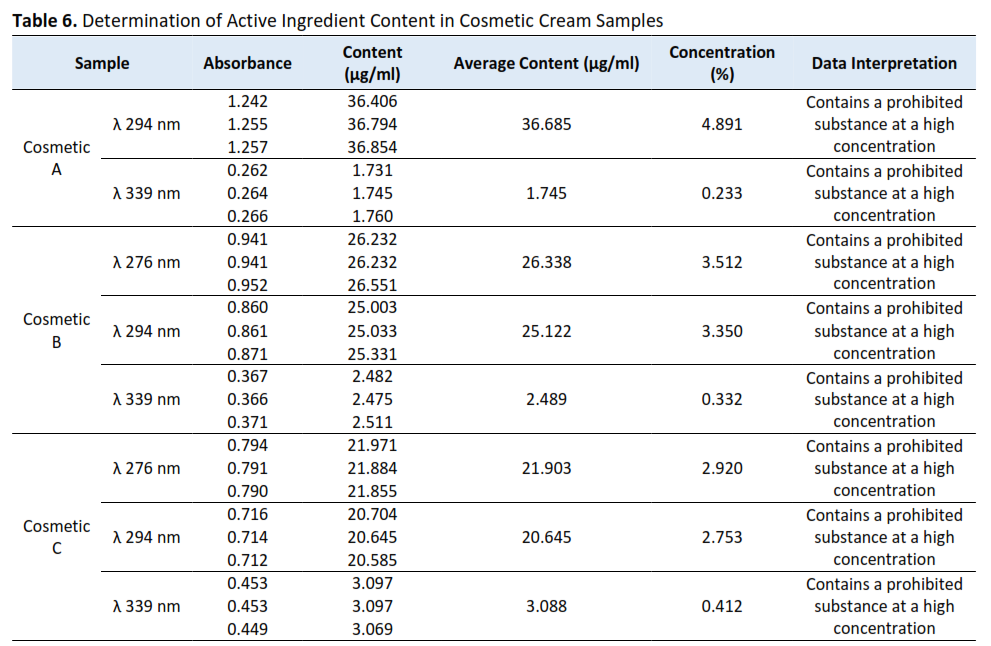
Results: The method showed excellent linearity (R² = 0.9998–0.9999), recoveries of 99.15%–100.15%, and precision with %RSD below 2%. LOD values for hydroquinone, tretinoin, and resorcinol were 0.698, 0.078, and 0.740 µg/mL, respectively; corresponding LOQ values were 2.328, 0.261, and 2.466 µg/mL. Pharmaceutical cream results were consistent with label claims. Cosmetic cream A contained hydroquinone and tretinoin, whereas cosmetic creams B and C contained all three analytes. The measured concentrations reached 4.891% hydroquinone, 0.412% tretinoin, and 3.512% resorcinol.
Conclusions: Sample A contains hydroquinone and resorcinol, while samples B and C contain hydroquinone, tretinoin, and resorcinol, respectively, with very high levels in all types of cosmetic cream samples.
References
1. Badan Pengawas Obat dan Makanan Republik Indonesia. Peraturan Kepala Badan Pengawas Obat dan Makanan Republik Indonesia Nomor HK.03.1.23.08.11.07331 Tahun 2011 tentang Metode Analisis Kosmetika [Regulation of the Head of the Indonesian Food and Drug Authority No. HK.03.1.23.08.11.07331 of 2011 concerning Cosmetic Analysis Methods]. BPOM RI; 2011.
2. Maggadani BP, Harmita, Harahap Y, Hutabalian HL. Simultaneous identification and quantification of hydroquinone, tretinoin and betamethasone in cosmetic products by isocratic reversed phase high performance liquid chromatography. Int J Appl Pharm. 2019;11(3):181-185. doi:10.22159/ijap.2019v11i3.32297
3. Desai P, Mori K, Patel MM. Development and validation of UV-visible spectrophotometric method for simultaneous estimation of mometasone furoate, hydroquinone and tretinoin from their pharmaceutical dosage form. Int J Pharm Sci Rev Res. 2013;21(1):296-300. doi: 10.22159/ijap.2017v9i5.20467
4. Kurniawan EN, Nugraha F, Kurniawan H. Analisis kandungan hidrokuinon pada krim pemutih dengan metode spektrofotometri UV-Vis [Analysis of hydroquinone content in whitening cream by UV-Vis spectrophotometry]. J Syifa Sci Clin Res. 2022;4(3):768-777. doi:10.37311/jsscr.v4i3.15285
5. Kurniawati A, Riyanto S, Rohman A. Validation of UV-Vis spectrophotometric method for determination of hydroquinone in cosmetic cream. Makara J Sci. 2022;26(4):251-257. doi:10.7454/mss.v26i4.1343
6. Ruchiyat Z, Jannah NR, Shalihat A. Qualitative and quantitative analysis of hydroquinone content in marketplace facial whitening creams. Chim Didact Acta. 2023;11(1):21-25. doi:10.24815/jcd.v11i1.32162
7. Pratiwi RA, Nandiyanto ABD. How to read and interpret UV-VIS spectrophotometric results in determining the structure of chemical compounds. Indones J Educ Res Technol. 2022;2(1):1-20. doi:10.17509/ijert.v2i1.35171
8. National Center for Biotechnology Information. PubChem compound summary for CID 5054, Resorcinol. PubChem. Accessed August 5, 2025. https://pubchem.ncbi.nlm.nih.gov/compound/Resorcinol
9. Kementerian Kesehatan Republik Indonesia. Farmakope Indonesia [Indonesian Pharmacopoeia]. 6th ed. Kementerian Kesehatan Republik Indonesia; 2020.
10. Elzanfaly ES, Saad AS, Abd-Elaleem AB. Simultaneous determination of retinoic acid and hydroquinone in skin ointment using spectrophotometric technique (ratio difference method). Saudi Pharm J. 2012;20(3):249-253. doi:10.1016/j.jsps.2012.03.004
11. Dachriyanus. Analisis Struktur Senyawa Organik Secara Spektroskopi [Spectroscopic Analysis of Organic Compound Structures]. LPTIK Universitas Andalas; 2004.
12. Indrayanto G. Application of accuracy and precision evaluations based on the current United States and Indonesian pharmacopoeias: A critical review. Makara J Sci. 2022;26(4):227-237. doi:10.7454/mss.v26i4.1343
13. Sharma S, Goyal S, Chauhan K. A review on analytical method development and validation. Int J Appl Pharm. 2018;10(6):8-15. doi:10.22159/ijap.2018v10i6.28279
14. Forootan A, Sjöback R, Björkman J, Sjögreen B, Linz L, Kubista M. Methods to determine limit of detection and limit of quantification in quantitative real-time PCR (qPCR). Biomol Detect Quantif. 2017;12:1-6. doi:10.1016/j.bdq.2017.04.001
15. Betz JM, Brown PN, Roman MC. Accuracy, precision, and reliability of chemical measurements in natural products research. Fitoterapia. 2010;82(1):44-52. doi:10.1016/j.fitote.2010.09.011
16. Sa’adah A, Rahmawati A, Pratiwi DA, Pangastuti KT, Aziza MR, Nabila VR. Validation of analysis method for determining content of chlorpheniramine malate (CTM) in tablet preparation by UV spectrophotometry. Science and Community Pharmacy Journal. 2023;2(2):149-154. doi:10.63520/scpj.v2i2.483
17. Kaur S, Kaur T, Kaur G, Verma S. Development and validation of UV-spectrophotometric method for estimation of hydroquinone in bulk, marketed cream and prepared NLC formulation. Int J Appl Pharm. 2017;9(5):102-108. doi:10.22159/ijap.2017v9i5.20467
18. Sulistyani M, Huda N, Prasetyo R, Alauhdin M. Calibration of microplate UV-Vis spectrophotometer for quality assurance testing of vitamin C using calibration curve method. Indones J Chem Sci. 2023;12(2):207-215. doi:10.15294/ijcs.v12i2.72451
19. Mammone FR, Zanitti L, Puxeddu M, La Regina G, Silvestri R, Borioni A, Cirilli R. A novel validated UHPLC method for the estimation of rosuvastatin and its complete impurity profile in tablet formulations. Molecules. 2023;28(1):431. doi:10.3390/molecules28010431
20. Matope A, Lees RS, Spiers A, Foster GM. A bioassay method validation framework for laboratory and semi-field tests used to evaluate vector control tools. Malar J. 2023;22(1):289. doi:10.1186/s12936-023-04717-w
21. Kumari M, Tripathy DB, Gupta A. Analytical methods and their significance in pharmaceutical process impurities: a review. Macromol Symp. 2024;413(1):2300026. doi:10.1002/masy.202300026
22. Pokar D, Rajput N, Sengupta P. Industrial approaches and consideration of clinical relevance in setting impurity level specification for drug substances and drug products. Int J Pharm. 2020;576:119018. doi:10.1016/j.ijpharm.2019.119018
23. Putri VS. Validation of UV-Vis spectrophotometric method to determine drug release of quercetin loaded-nanoemulsion. Indones J Pharm. 2022;34(2):272-279. doi:10.22146/ijp.4454
24. United States Pharmacopeial Convention. United States Pharmacopeia and National Formulary (USP 44–NF 39). United States Pharmacopeial Convention; 2021
25. Banodkar P, Banodkar K. History of hydroquinone. Indian J Dermatol Venereol Leprol. 2022;88(5):696-699. doi:10.25259/IJDVL_657_2021
26. Rahmayuni E, Harmita, Suryadi H. Development and validation method for simultaneous analysis of retinoic acid, hydroquinone and corticosteroid in cream formula by high-performance liquid chromatography. J Appl Pharm Sci. 2018;8(9):87-92. doi:10.7324/JAPS.2018.8913
27. Khairy MA, Hamad A, Hamed M, Locatelli M, Mansour FR. A stability indicating RP-HPLC-UV assay method for the simultaneous determination of hydroquinone, tretinoin, hydrocortisone, butylated hydroxytoluene and parabens in pharmaceutical creams. J Pharm Biomed Anal. 2024;242:116021. doi:10.1016/j.jpba.2024.116021
Downloads
Submitted
Accepted
Published
How to Cite
Issue
Section
License
Copyright (c) 2026 Aji Putra Raharjo, Sukrasno Sukrasno, Winni Nur Auli, Akmal Hammami

This work is licensed under a Creative Commons Attribution-NonCommercial-ShareAlike 4.0 International License.