Prescribing and Transcribing Problems in Electronic Pediatric Compounded Prescriptions: A Descriptive Study in Outpatient and Inpatient Services at Hospital X
DOI:
https://doi.org/10.36733/medicamento.v12i2.14848Keywords:
electronic prescribing, pediatric compounded prescriptions, prescribing problems, prescription information, transcribing problemsAbstract
Background: Accurate prescription information supports safe review and preparation of pediatric compounded medicines, particularly during transfer between prescribing and pharmacy systems.
Objective: This study aimed to describe the profile of electronic pediatric compounded prescriptions and descriptively compare the proportions and distributions of identified prescribing and transcribing problems between outpatient and inpatient services at Hospital X.
Methods: A descriptive, retrospective observational study was conducted using pediatric compounded prescriptions recorded in e-Calyptus from January to December 2025. Using purposive sampling, 488 prescriptions were included (216 outpatient, 272 inpatient). Prescribing problems were assessed using predefined administrative, pharmaceutical, and specified clinical prescription-review criteria. Transcribing problems were identified by comparing e-Calyptus records with corresponding Buana entries; only problems newly introduced during information transfer were counted.
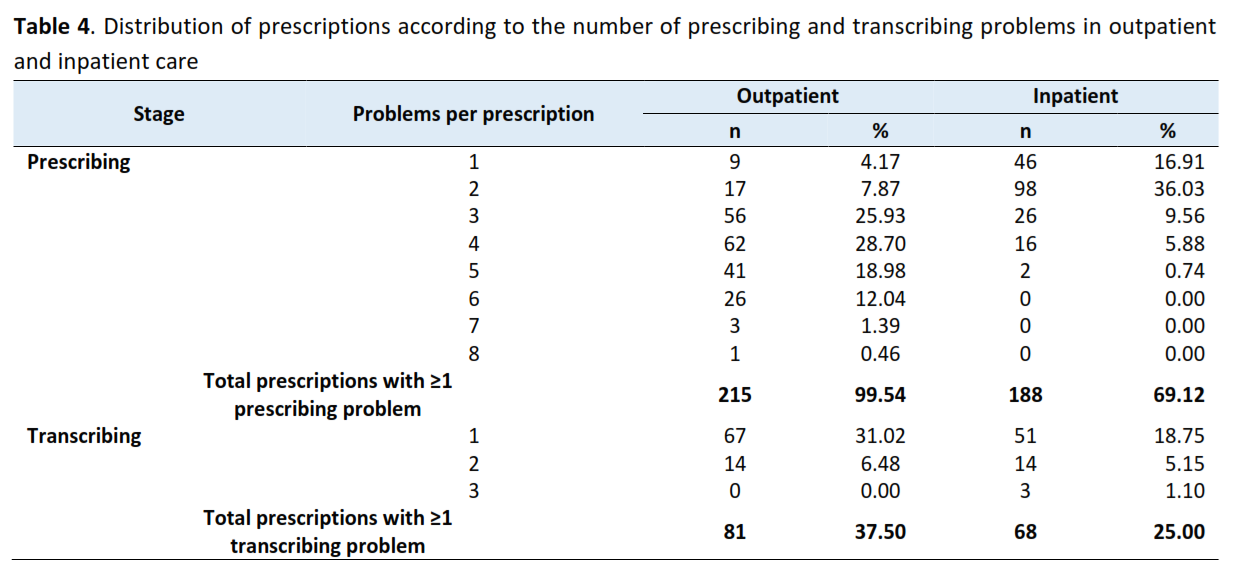
Results: Most prescriptions involved children aged five years or younger, contained a single medication item, and were prepared as divided powders. At least one prescribing problem was identified in 99.54% of outpatient and 69.12% of inpatient prescriptions. Newly introduced transcribing problems occurred in 37.50% and 25.00%, respectively. Multiple concurrent prescribing problems per prescription were more frequent in outpatient care. Prescribing problems most often involved missing dosage form and route of administration, while transcribing problems mainly involved dose information, dosing instructions, and dosage form.
Conclusion: Pediatric compounded prescription records show documented problems in source prescriptions and during subsequent information transfer. Differences between outpatient and inpatient services are descriptive and do not establish causal effects of care setting. These findings support improving prescription completeness, cross-system information consistency, and systematic prescription verification.
References
1. Ministry of Health of the Republic of Indonesia. Regulation of the Minister of Health of the Republic of Indonesia No. 72 of 2016 on Standards of Pharmaceutical Care in Hospitals. Jakarta, Indonesia: Ministry of Health of the Republic of Indonesia; 2016. https://farmalkes.kemkes.go.id/unduh/permenkes-72-2016/
2. Yuliani SH, Putri DCA, Virginia DM, Gani MR, Riswanto FDO. Prevalence, risk, and challenges of extemporaneous preparation for pediatric patients in developing nations: a review. Pharmaceutics. 2023;15(3):840. doi:10.3390/pharmaceutics15030840
3. D'Errico S, Zanon M, Radaelli D, Padovano M, Santurro A, Scopetti M, Frati P, Fineschi V. Medication errors in pediatrics: proposals to improve the quality and safety of care through clinical risk management. Front Med (Lausanne). 2022;8:814100. doi:10.3389/fmed.2021.814100
4. Yuliani SH, Putri DCA, Widayati A, Abiyoga B. Compounding practice in a developing country: a case study of divided powder in Indonesia. Res J Pharm Technol. 2020;13(12):6231-6237. doi:10.5958/0974-360X.2020.01086.0
5. Gildon BL, Condren M, Hughes CC. Impact of electronic health record systems on prescribing errors in pediatric clinics. Healthcare (Basel). 2019;7(2):57. doi:10.3390/healthcare7020057
6. Tolley CL, Forde NE, Coffey KL, Sittig DF, Ash JS, Husband AK, Bates DW, Slight SP. Factors contributing to medication errors made when using computerized order entry in pediatrics: a systematic review. J Am Med Inform Assoc. 2018;25(5):575-584. doi:10.1093/jamia/ocx124
7. Ruutiainen HK, Holmström AR, Kunnola E, Kuitunen S. Use of computerized physician order entry with clinical decision support to prevent dose errors in pediatric medication orders: a systematic review. Paediatr Drugs. 2024;26(2):127-143. doi:10.1007/s40272-023-00614-6
8. Westbrook JI, Li L, Raban MZ, Mumford V, Badgery-Parker T, Gates P, Fitzpatrick E, Merchant A, Woods A, Baysari M, McCullagh C, Day R, Gazarian M, Dickinson M, Seaman K, Dalla-Pozza L, Ambler G, Barclay P, Gardo A, O'Brien T, Barbaric D, White L. Short- and long-term effects of an electronic medication management system on paediatric prescribing errors. NPJ Digit Med. 2022;5(1):179. doi:10.1038/s41746-022-00739-x
9. Howlett MM, Butler E, Lavelle KM, Cleary BJ, Breatnach CV. The impact of technology on prescribing errors in pediatric intensive care: a before and after study. Appl Clin Inform. 2020;11(2):323-335. doi:10.1055/s-0040-1709508
10. Tan L, Chen W, He B, Zhu J, Cen X, Feng H. A survey of prescription errors in paediatric outpatients in multi-primary care settings: the implementation of an electronic pre-prescription system. Front Pediatr. 2022;10:880928. doi:10.3389/fped.2022.880928
11. Brennan-Bourdon LM, Vázquez-Álvarez AO, Gallegos-Llamas J, Koninckx-Cañada M, Marco-Garbayo JL, Huerta-Olvera SG. A study of medication errors during the prescription stage in the pediatric critical care services of a secondary-tertiary level public hospital. BMC Pediatr. 2020;20:549. doi:10.1186/s12887-020-02442-w
12. Parrish RH II, Gilak L, Bohannon D, Emrick SP, Serumaga B, Guharoy R. Minimizing medication errors from electronic prescription transmission—digitizing compounded drug preparations. Pharmacy (Basel). 2019;7(4):149. doi:10.3390/pharmacy7040149
13. Parrish RH II, Ciarkowski SL, Aguero D, Benavides S, Bohannon DZ, Guharoy R; United States Pharmacopeia Compounded Drug Preparation Information Exchange Expert Panel. Creating data standards to support the electronic transmission of compounded nonsterile preparations (CNSPs): perspectives of a United States Pharmacopeia expert panel. Children (Basel). 2022;9(10):1493. doi:10.3390/children9101493
14. Zheng Y, Jiang Y, Dorsch MP, Ding Y, Vydiswaran VGV, Lester CA. Work effort, readability and quality of pharmacy transcription of patient directions from electronic prescriptions: a retrospective observational cohort analysis. BMJ Qual Saf. 2021;30(4):311-319. doi:10.1136/bmjqs-2019-010405
15. Farghali AA, Borycki EM. A preliminary scoping review of the impact of e-prescribing on pharmacists in community pharmacies. Healthcare (Basel). 2024;12(13):1280. doi:10.3390/healthcare12131280
16. Hannibal GD, Vithanage NVNN, Madhushika MT, Sinhabahu TK, Kankananarachchi I, Liyanage PLGC. A systematic review of prescription errors in paediatric care. BMC Health Serv Res. 2025;25(1):967. doi:10.1186/s12913-025-13109-6
17. Takele B, Koyra HC, Sidamo T, Lerango TL. Tripled likelihood: polypharmacy increases the occurrence of drug therapy problems in hospitalized pediatric patients. Front Pharmacol. 2024;15:1375728. doi:10.3389/fphar.2024.1375728
18. Ivanovska V, Rademaker CMA, van Dijk L, Mantel-Teeuwisse AK. Pediatric drug formulations: a review of challenges and progress. Pediatrics. 2014;134(2):361-372. doi:10.1542/peds.2013-3225
19. Nithya S, Shankar R, Nisha S, Ramya M, Ranjitha R, Arul B, Karishma J. Rationality of antibiotic use in lower respiratory tract infections in paediatric patients. Int J Drug Deliv Technol. 2026;16(43s):1309-1314. doi:10.25258/ijddt.16.43s.136
20. Peer V, Mandelboim M, Jurkowicz M, Green MS. Sex differences in acute respiratory tract infections—multi-year analysis based on data from a large tertiary care medical center in Israel. Front Public Health. 2025;13:1502036. doi:10.3389/fpubh.2025.1502036
21. Pai VB, Nahata MC. Extemporaneous formulations for pediatric patients: global necessities, challenges and opportunities. Pharmaceutics. 2026;18(1):126. doi:10.3390/pharmaceutics18010126
22. Angresius R, Wyss K, Reppucci D, Rebling F, Subotic U, Gotta V. Drug prescription before and after implementation of a CPOE system on the Paediatric Intensive Care Unit: a quality improvement study. Swiss Med Wkly. 2026;156:4978. doi:10.57187/4978
23. Ab Rahman N, Low EV, Kamaruddin F, Che Ayub A, Chong SC, Tumiran N, Idris N. A retrospective study on prevalence, characteristics, and outcomes of transcribing error: analysis of data from the National Medication Error Reporting System in Malaysia. J Pharm Policy Pract. 2025;18(1):2528244. doi:10.1080/20523211.2025.2528244
24. Liang MQ, Thibault M, Jouvet P, Lebel D, Schuster T, Moreault MP, Motulsky A. Improving medication safety in a paediatric hospital: a mixed-methods evaluation of a newly implemented computerised provider order entry system. BMJ Health Care Inform. 2023;30(1):e100622. doi:10.1136/bmjhci-2022-100622
25. Leviatan I, Oberman B, Zimlichman E, Stein GY. Associations of physicians' prescribing experience, work hours, and workload with prescription errors. J Am Med Inform Assoc. 2021;28(6):1074-1080. doi:10.1093/jamia/ocaa219
26. Naseralallah LM, Hussain TA, Jaam M, Pawluk SA. Impact of pharmacist interventions on medication errors in hospitalized pediatric patients: a systematic review and meta-analysis. Int J Clin Pharm. 2020;42(4):979-994. doi:10.1007/s11096-020-01034-z
27. Satir AN, Pfiffner M, Meier CR, Caduff Good A. Prescribing errors in children: what is the impact of a computerized physician order entry? Eur J Pediatr. 2023;182(6):2567-2575. doi:10.1007/s00431-023-04894-5
Downloads
Submitted
Accepted
Published
How to Cite
Issue
Section
License
Copyright (c) 2026 Jenny Pontoan, Nizar Pajriah, Siswati Siswati

This work is licensed under a Creative Commons Attribution-NonCommercial-ShareAlike 4.0 International License.