Anti-Inflammatory Potential of 6-Gingerol and 6-Shogaol from Zingiber officinale: Scientific Evidence and Clinical Relevance
DOI:
https://doi.org/10.36733/usadha.v5i2.14993Keywords:
Zingiber officinale, 6-gingerol, 6-shogaol, anti-inflammatory, traditional medicineAbstract
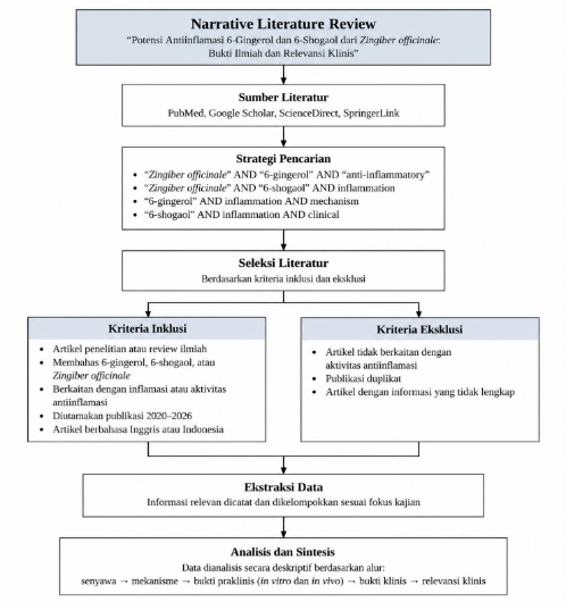
Zingiber officinale (ginger) is a medicinal plant widely used in traditional medicine and contains bioactive compounds, including 6-gingerol and 6-shogaol. This review aimed to evaluate the anti-inflammatory potential of both compounds based on molecular, preclinical, and clinical evidence and to assess their relevance to the development of anti-inflammatory therapies. A narrative literature review was conducted using PubMed, Google Scholar, ScienceDirect, and SpringerLink. The literature was searched using keywords related to Z. officinale, 6-gingerol, 6-shogaol, inflammation, anti-inflammatory mechanisms, and clinical evidence. Eligible literature comprised primary research articles and scientific reviews published in Indonesian or English between 2020 and August 2026 that were relevant to the review focus. In vitro evidence indicated that 6-gingerol and 6-shogaol modulated NF-κB, MAPK, and mTOR signaling pathways and reduced pro-inflammatory mediators. In vivo evidence supported their anti-inflammatory activity through regulation of inflammatory mediators, the NLRP3 inflammasome, and oxidative stress. Direct clinical evidence for the isolated compounds remains limited, with most human data derived from ginger preparations containing multiple constituents. Therefore, the anti-inflammatory potential of 6-gingerol and 6-shogaol is supported primarily by preclinical evidence, whereas their individual clinical efficacy requires confirmation through controlled clinical trials using standardized doses and formulations.
References
Maghraby YR, Labib RM, Sobeh M, Farag MA. Gingerols and shogaols: A multi-faceted review of their extraction, formulation, and analysis in drugs and biofluids to maximize their nutraceutical and pharmaceutical applications. Food Chem X. 2023;20:100947. doi:10.1016/j.fochx.2023.100947.
[2]. Ayustaningwarno F, Anjani G, Ayu AM, Fogliano V. A critical review of Ginger’s (Zingiber officinale) antioxidant, anti-inflammatory, and immunomodulatory activities. Front Nutr. 2024;11:1364836. doi:10.3389/fnut.2024.1364836.
[3]. Sukweenadhi J, Damitasari PD, Kartini, Christanti P, Putri EN. Gingerol and shogaol on red ginger rhizome (Zingiber officinale var. Rubrum) using high-performance liquid chromatography. Pharmaciana. 2023;13(2). doi:10.12928/pharmaciana.v13i2.25246.
[4]. Promdam N, Panichayupakaranant P. [6]-Gingerol: A narrative review of its beneficial effect on human health. Food Chem Adv. 2022;1:100043. doi:10.1016/j.focha.2022.100043.
[5]. Ghasemzadeh A, Jaafar HZE, Baghdadi A, Tayebi-Meigooni A. Formation of 6-, 8- and 10-Shogaol in Ginger through Application of Different Drying Methods: Altered Antioxidant and Antimicrobial Activity. Molecules. 2018;23(7):1646. doi:10.3390/molecules23071646.
[6]. Liu Y, Deng S, Zhang Z, Gu Y, Xia S, Bao X, et al. 6-Gingerol attenuates microglia-mediated neuroinflammation and ischemic brain injuries through Akt-mTOR-STAT3 signaling pathway. Eur J Pharmacol. 2020;883:173294. doi:10.1016/j.ejphar.2020.173294.
[7]. Zhang FL, Zhou BW, Yan ZZ, Zhao J, Zhao BC, Liu WF, et al. 6-Gingerol attenuates macrophages pyroptosis via the inhibition of MAPK signaling pathways and predicts a good prognosis in sepsis. Cytokine. 2020;125:154854. doi:10.1016/j.cyto.2019.154854.
[8]. Bischoff-Kont I, Primke T, Niebergall LS, Zech T, Fürst R. Ginger constituent 6-shogaol inhibits inflammation- and angiogenesis-related cell functions in primary human endothelial cells. Front Pharmacol. 2022;13:844767. doi:10.3389/fphar.2022.844767.
[9]. Umar T, Yin B, He L, Feng W, Yuan Y, Umer S, et al. 6-Gingerol via overexpression of miR-322-5p impede lipopolysaccharide-caused inflammatory response in RAW264.7 cells. Naunyn Schmiedebergs Arch Pharmacol. 2023;396(12):3797-3807. doi:10.1007/s00210-023-02543-0.
[10]. Hosseini A, Alavi MS, Ghane Nikookar Toos M, Jamialahmadi T, Sahebkar A. 6-Gingerol, an ingredient of Zingiber officinale, abrogates lipopolysaccharide-induced cardiomyocyte injury by reducing oxidative stress and inflammation. J Agric Food Res. 2024;15:101034. doi:10.1016/j.jafr.2024.101034.
[11]. Sheng Y, Wu T, Dai Y, Xu L, Zhong Y, Xue Y, et al. 6-Gingerol alleviates inflammatory injury in DSS-induced ulcerative colitis mice by regulating NF-κB signaling. Ann Palliat Med. 2020;9(4):1944-1952. doi:10.21037/apm-20-903.
[12]. Guo XX, Zhang YD, Wang TC, Wang XL, Xu YY, Wang Y, et al. Ginger and 6-gingerol prevent lipopolysaccharide-induced intestinal barrier damage and liver injury in mice. J Sci Food Agric. 2022;102(3):1066-1075. doi:10.1002/jsfa.11442.
[13]. Qiu JL, Chai YN, Duan FY, Zhang HJ, Han XY, Chen LY, et al. 6-Shogaol alleviates CCl4-induced liver fibrosis by attenuating inflammatory response in mice through the NF-κB pathway. Acta Biochim Pol. 2022;69(2):363-370. doi:10.18388/abp.2020_5802.
[14]. Yang AY, Kim K, Kwon HH, Leem J, Song JE. 6-Shogaol ameliorates liver inflammation and fibrosis in mice on a methionine- and choline-deficient diet by inhibiting oxidative stress, cell death, and endoplasmic reticulum stress. Molecules. 2024;29(2):419. doi:10.3390/molecules29020419.
[15]. Bischoff-Kont I, Fürst R. Benefits of ginger and its constituent 6-shogaol in inhibiting inflammatory processes. Pharmaceuticals. 2021;14(6):571. doi:10.3390/ph14060571.
[16]. Pázmándi K, Ágics B, Szöllősi AG, Bácsi A, Fekete T. Ginger-derived bioactive compounds attenuate the Toll-like receptor mediated responses of human dendritic cells. Eur J Pharmacol. 2024;967:176399. doi:10.1016/j.ejphar.2024.176399.
[17]. Morvaridzadeh M, Fazelian S, Agah S, Khazdouz M, Rahimlou M, Agh F, et al. Effect of ginger (Zingiber officinale) on inflammatory markers: A systematic review and meta-analysis of randomized controlled trials. Cytokine. 2020;135:155224. doi:10.1016/j.cyto.2020.155224.
[18]. Jalali M, Mahmoodi M, Moosavian SP, Jalali R, Ferns G, Mosallanezhad A, et al. The effects of ginger supplementation on markers of inflammatory and oxidative stress: A systematic review and meta-analysis of clinical trials. Phytother Res. 2020;34(8):1723-1733. doi:10.1002/ptr.6638.
[19]. Baek HI, Shen L, Ha KC, Park YK, Kim CS, Kwon JE, et al. Effectiveness and safety of steamed ginger extract on mild osteoarthritis: A randomized, double-blind, placebo-controlled clinical trial. Food Funct. 2024;15:9512-9523. doi:10.1039/D4FO01640H.
[20]. Zick SM, Djuric Z, Ruffin MT, Litzinger AJ, Normolle DP, Alrawi S, et al. Pharmacokinetics of 6-gingerol, 8-gingerol, 10-gingerol, and 6-shogaol and conjugate metabolites in healthy human subjects. Cancer Epidemiol Biomarkers Prev. 2008;17(8):1930-1936. doi:10.1158/1055-9965.EPI-07-2934.
[21]. Suekawa M, Ishige A, Yuasa K, Sudo K, Aburada M, Hosoya E. Pharmacological studies on ginger. I. Pharmacological actions of pungent constituents, (6)-gingerol and (6)-shogaol. J Pharmacobiodyn. 1984;7(11):836-848. doi:10.1248/bpb1978.7.836.
Downloads
Published
Issue
Section
License
Copyright (c) 2026 I Gede Pasek Winantara Putra, Putu Oka Samirana

This work is licensed under a Creative Commons Attribution-NonCommercial 4.0 International License.