Toxicity Test of Kenop Flower Ethanol Extract (Gomphrena globosa Linn.) Using Brine Shirp Lethality Test (BSLT) Method
DOI:
https://doi.org/10.36733/usadha.v5i2.14789Keywords:
Brine Shirp LethalIty Test (BSLT), Gomphrena globosa Linn., Lethal Concentration (LC)50Abstract
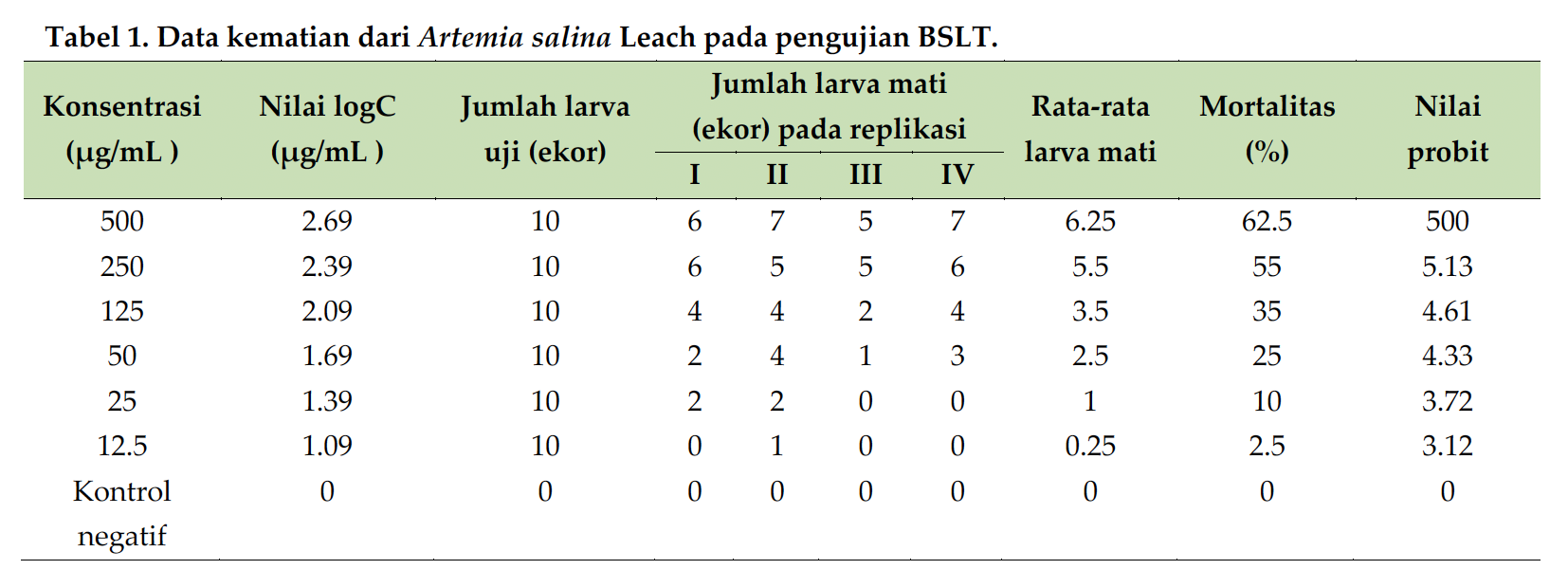
Advances in healthcare and drug development have continued to encourage the exploration of bioactive compounds derived from natural sources. One plant with potential for further development is globe amaranth (Gomphrena globosa Linn.). This study aimed to evaluate the toxicity of the ethanolic extract of globe amaranth (G. globosa) flowers based on its LC₅₀ value using the Brine Shrimp Lethality Test (BSLT) method. This study was conducted as a laboratory-based experimental study. Data were obtained from laboratory testing and supported by a literature review. Globe amaranth (G. globosa) flower samples were obtained from farmers in Sanur, Denpasar, Bali. Extraction was performed by maceration using 80% ethanol, followed by phytochemical screening to identify the presence of flavonoids. Toxicity testing was conducted using Artemia salina larvae, and mortality data were subsequently analysed using probit analysis and linear regression to determine the LC₅₀ value. Phytochemical screening showed that the ethanolic extract of G. globosa flowers tested positive for flavonoids. The regression equation obtained was y = 13589x + 1.7924, with a correlation coefficient (R²) of 0.9707 and an LC₅₀ value of 228.620 µg/mL . Based on these findings, the ethanolic extract of G. globosa flowers exhibited toxic effects against A. salina and was classified as toxic according to the BSLT method. These findings indicate the presence of biological activity in the extract and may provide a basis for further studies investigating its pharmacological potential and safety profile.
References
[1]. Adiyasa MR, Meiyanti M. Pemanfaatan obat tradisional di Indonesia: distribusi dan faktor demografis yang berpengaruh. J Biomedika Kesehat. 2021;4(3):130–138. doi:10.18051/JBiomedKes.2021.v4.130-138.
[2]. Cahyaningsih E, Dewi NLKAA, Yuda PESK, Irlangga IGNAAST. Penentuan kadar total flavonoid pada ekstrak bunga kenop (Gomphrena globosa L.) dengan metode spektrofotometri UV-Vis. Usadha J Integr Obat Tradis. 2025;4(3):98–102.
[3]. Kurniawan H, Ropiqa M. Uji toksisitas ekstrak etanol daun ekor kucing (Acalypha hispida Burm.f.) dengan metode Brine Shrimp Lethality Test (BSLT). J Syifa Sci Clin Res. 2021;3(2):52–62.
[4]. Puspita Sari DRA. Uji toksisitas ekstrak etanol 96% daun cincau hijau (Cyclea barbata Miers) terhadap Artemia salina Leach. dengan metode Brine Shrimp Lethality Test (BSLT). J Pharmactive. 2024;3(1):8–15.
[5]. Lestari KS, Widiati AU, Istiqomah AN. Pengaruh toksisitas akut ekstrak etanol rimpang pacing (Costus speciosus) pada embrio zebrafish (Danio rerio). Indones J Herb Sci Innov. 2025;1(1):45–59. doi:10.64673/ijherbsi.v1i1.2.
[6]. Książkiewicz M, Karczewska M, Nawrot F, Grabowska K, Szymański M, Cielecka-Piontek J, et al. Edible flowers as bioactive food ingredients with antidiabetic potential: a study on Paeonia officinalis L., Forsythia × intermedia, Gomphrena globosa L., and Clitoria ternatea L. Plants. 2025;14(16):2603. doi:10.3390/plants14162603.
[7]. Araque Gelves DI, de Andreoli Souza GC, Hernandez Tasco AJ, Salvador MJ. Ethnomedicinal uses, phytochemistry, pharmacological activities, and toxicology of the subfamily Gomphrenoideae (Amaranthaceae): a comprehensive review. Chem Biodivers. 2025;22(9). doi:10.1002/cbdv.202500530.
[8]. Bujak T, Zagórska-Dziok M, Ziemlewska A, Nizioł-Łukaszewska Z, Lal K, Wasilewski T, et al. Flower extracts as multifunctional dyes in the cosmetics industry. Molecules. 2022;27(3):922. doi:10.3390/molecules27030922.
[9]. Hasibuan AS, Edrianto V, Purba N. Skrining fitokimia ekstrak etanol umbi bawang merah (Allium cepa L.). J Farmasimed. 2020;2(2):45–49. doi:10.35451/jfm.v2i2.357.
[10]. Sagala VZ, Ridwanto, Daulay AS, Pulungan AF. Toxicity test using the BSLT method and antibacterial test against Staphylococcus aureus and Escherichia coli of the extract and fractions of karamunting leaves (Rhodomyrtus tomentosa (Aiton) Hassk.). J Pharm Sci. 2025;8(1):603–625. doi:10.36490/journal-jps.com.v8i1.823.
[11]. Haryanto, Ashara RA, Ode NF, Syahrani A, Abni NA, Sandrina NN, et al. Penentuan nilai LC50 dan kategori toksisitas ekstrak etanol akar trembesi (Albizia saman) melalui analisis probit. J Penelit Nusant. 2026;2(7):1301–1306. doi:10.59435/menulis.v2i7.1439.
[12]. Karim FY, Kawung NJ, Wagey BT. Uji toksisitas dari ekstrak lamun jenis Thalassia hemprichii dari perairan Kalasey dengan menggunakan metode Brine Shrimp Lethality Test. J Pesisir Laut Trop. 2019;7(3):265–270. doi:10.35800/jplt.7.3.2019.26017.
[13]. Hamiduzzaman M, Azam ATMZ. Antimicrobial, antioxidant and cytotoxic activities of Gomphrena globosa (L.). Bangladesh Pharm J. 2012;15(2):183–185.
[14]. Susilaningrum DF, Fajarwati D, Wijayanti N. Antioxidant potential and cytotoxic assay of ethanol extract of Gomphrena globosa L. flower. AIP Conf Proc. 2020;2260(1):040010.
Downloads
Published
Issue
Section
License
Copyright (c) 2026 Made Darmawan, Erna Cahyaningsih, I Wayan Surya Rahadi, Putu Era Sandhi Kusuma Yuda, Gede Agus Ari Tirtayasa, Ni Luh Kade Arman Anita Dewi

This work is licensed under a Creative Commons Attribution-NonCommercial 4.0 International License.