Effectiveness and Safety of Saffron (Crocus sativus) in Improving Sleep Quality in Patients with Sleep Disorders: A Literature Review
DOI:
https://doi.org/10.36733/usadha.v5i1.13097Keywords:
saffron, Crocus sativus, crocin, sleep disorder, complementary herbal therapyAbstract
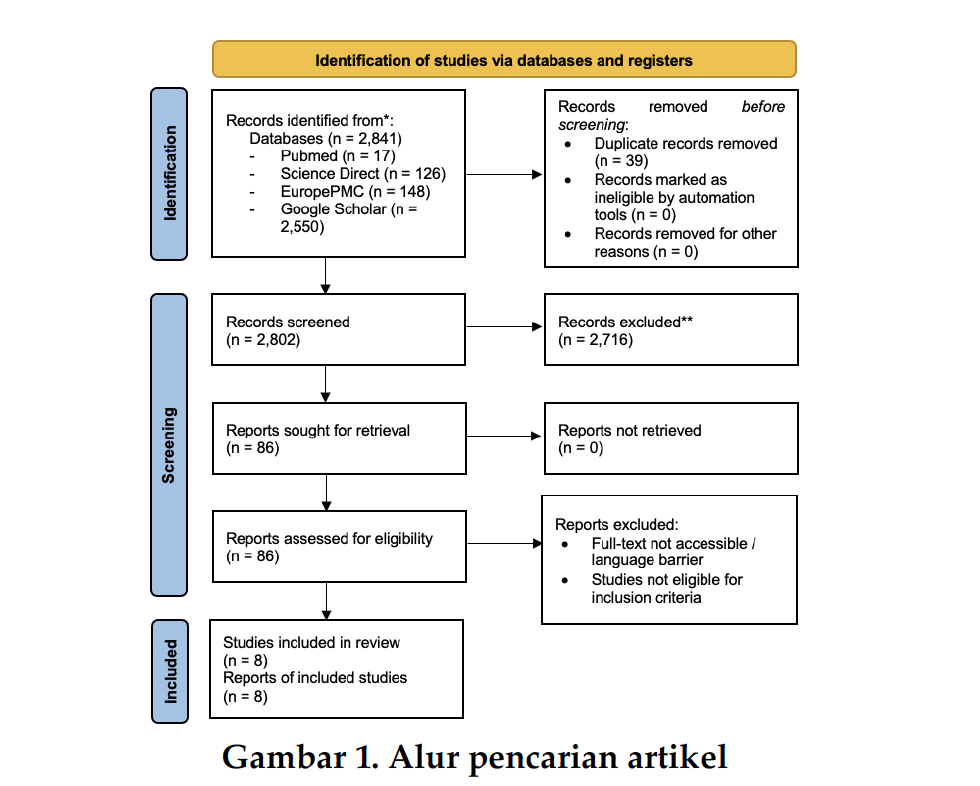
Sleep disorders are global health problems that impair physiological function, psychological well-being, and overall quality of life. Conventional pharmacological therapies often have limitations and adverse effects, creating a need for safer alternatives. Saffron (Crocus sativus), which contains crocin, crocetin, and safranal, has reported neuromodulatory, anti-inflammatory, and anxiolytic properties that may improve sleep quality. This study aimed to review the scientific evidence regarding the safety and effectiveness of saffron in improving sleep quality among individuals with sleep disorders. The study conducted a systematic literature search in PubMed, ScienceDirect, EuropePMC, and Google Scholar using keywords related to saffron and sleep quality. The inclusion criteria were articles published in English or Indonesian within the last ten years. The exclusion criterion was closed-access articles. Data were analyzed qualitatively based on study design, type of intervention, and primary outcomes. The reviewed studies show that saffron consistently improves sleep quality, as reflected by lower PSQI and ISI scores, increased sleep duration, reduced sleep latency, and improvements in mood, anxiety, and melatonin levels. Its effectiveness appears in healthy individuals and in patients with comorbidities such as diabetes, depression, anxiety, and temporomandibular disorder. Saffron also shows a favorable safety profile without serious adverse effects at doses ranging from 14–30 mg/day to up to 300 mg/day for short-term use. Saffron shows potential as a complementary intervention for improving sleep quality through neuropsychological, anti-inflammatory, and hormonal mechanisms. It is effective and safe as adjunctive therapy for sleep disorders, although long-term studies are still needed.
Keywords: saffron, Crocus sativus, crocin, sleep disorder, complementary herbal therapy
References
[1]. Lopresti AL, Smith SJ, Metse AP, Drummond PD. Effects of saffron on sleep quality in healthy adults with self-reported poor sleep: a randomized, double-blind, placebo-controlled trial. J Clin Sleep Med. 2020;16(6):937-947.
[2]. Schuster J, Mundhenke C, Nordsieck H, Pouchieu C, Pourtau L, Hahn A. Effect of a saffron extract on sleep quality in adults with moderate insomnia: a decentralized, randomized, double-blind, placebo-controlled trial. Sleep Med X. 2025;10:100145.
[3]. Nishide A, Fujita T, Nagaregawa Y. Sleep enhancement by saffron extract Affron in a randomized controlled trial. Jpn Pharmacol Ther. 2018;46(8):1407-1413.
[4]. Milajerdi A, Jazayeri S, Shirzadi E, Hashemzadeh N, Azizgol A, Djazayery A, et al. The effects of alcoholic extract of saffron (Crocus sativus L.) on mild to moderate comorbid depression-anxiety, sleep quality, and life satisfaction in type 2 diabetes mellitus: a double-blind, randomized and placebo-controlled clinical trial. Complement Ther Med. 2018;41:196-202.
[5]. Dehghanmehr S, Shadadi H, Mansouri A, Arbabisarjou A. Effect of oral saffron capsules on sleep quality in patients with diabetes at Zabol, Iran. Bali Med J. 2017;6(3):595-599.
[6]. Shahdadi H, Balouchi A, Dehghanmehr S. Effect of saffron oral capsule on anxiety and quality of sleep of diabetic patients in a tertiary healthcare facility in southeastern Iran: a quasi-experimental study. Trop J Pharm Res. 2017;16(11):2749-2753.
[7]. Raja N, Ganesan A, Krithika CL, Aniyan Y. Effect of saffron extract on sleep quality and melatonin concentrations in adults with temporomandibular disorders: an observational study. Texila Int J Public Health. 2024;12(4):1-9.
[8]. Pachikian BD, Copine S, Suchareau M, Deldicque L. Effects of saffron extract on sleep quality: a randomized double-blind controlled clinical trial. Nutrients. 2021;13(5):1473.
[9]. Sateia MJ. International Classification of Sleep Disorders-Third Edition: highlights and modifications. Chest. 2014;146(5):1387-1394.
[10]. Bollu PC, Kaur H. Sleep medicine: insomnia and sleep. Mo Med. 2019;116(1):68-75.
[11]. Zisapel N. New perspectives on the role of melatonin in human sleep, circadian rhythms and their regulation. Br J Pharmacol. 2018;175(16):3190-3199.
[12]. Karna B, Sankari A, Tatikonda G. Sleep disorder. In: StatPearls [Internet]. Treasure Island (FL): StatPearls Publishing; 2025.
[13]. Riemann D, Krone LB, Wulff K, Nissen C. Sleep, insomnia, and depression. Neuropsychopharmacology. 2020;45(1):74-89.
[14]. Poma A, Fontecchio G, Carlucci G, Chichiricco G. Anti-inflammatory properties of drugs from saffron crocus. Anti Inflamm Allergy Agents Med Chem. 2012;11(1):37-51.
[15]. Christodoulou E, Kadoglou NPE, Kostomitsopoulos N, Valsami G. Saffron: a natural product with potential pharmaceutical applications. J Pharm Pharmacol. 2015;67(12):1634-1649.
[16]. Boskabady MH, Farkhondeh T. Anti-inflammatory, antioxidant, and immunomodulatory effects of Crocus sativus L. and its main constituents. Phytother Res. 2016;30(7):1072-1094.
[17]. Hosseinzadeh H, Noraei NB. Anxiolytic and hypnotic effect of Crocus sativus aqueous extract and its constituents, crocin and safranal, in mice. Phytother Res. 2009;23(6):768-774.
Downloads
Published
Issue
Section
License
Copyright (c) 2026 Ega Fitriana, Nadira Rifda Utami, Risya Lailatilkadri, Masayu Syarinta Adenina

This work is licensed under a Creative Commons Attribution-NonCommercial 4.0 International License.