Formulasi Dan Uji Mutu Fisik Sediaan Sabun Padat Dengan Penambahan Ekstrak Etanol Buah Pepaya (Carica papaya L.)
DOI:
https://doi.org/10.36733/usadha.v3i3.7296Kata Kunci:
ekstrak, buah pepaya, carica papaya, sabun padat, mutu fisikAbstrak
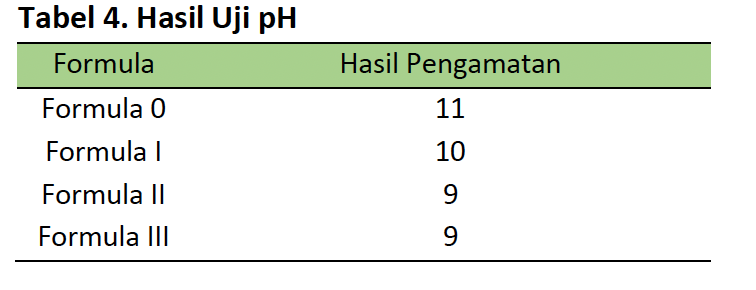
Buah pepaya mengandung senyawa metabolit sekunder seperti saponin. Metabolit sekunder yang diperlukan dalam produksi sabun yaitu saponin. Tujuan dari penelitian ini adalah Untuk mengetahui penambahan ekstrak etanol buah pepaya (Carica papaya L.) dengan konsentrasi 2,4 dan 6% pada sediaan sabun padat dapat menghasilkan mutu fisik yang baik dan untuk mengetahui perbedaan antara formula 0 (tanpa ekstrak) dengan formula I, II dan III (dengan konsentrasi ekstrak 2, 4 dan 6%) pada mutu fisik yang diperoleh. Penelitian ini merupakan penelitian eksperimental, diawali dengan membuat ekstrak yang kemudian diformulasikan ke dalam bentuk sabun padat dengan variasi konsentrasi ekstrak 2,4 dan 6%. Sabun yang dihasilkan berwarna putih pada formula 0 dan formula I dengan aroma fragrance aria sedangkan pada formula II berwarna kuning dan formula III berwarna jingga dengan aroma ekstrak etanol buah pepaya dan pada keempat formula tersebut memperoleh sediaan yang berbentuk padat. Hasil uji homogenitas pada semua formula sudah homogen. Hasil uji pH diperoleh nilai pH terendah pada formula II dan formula III dengan nilai pH 9 sedangkan nilai pH tertinggi diperoleh pada formula 0 dengan nilai pH 11. Hasil uji tinggi dan kestabilan busa diperoleh tinggi busa yang paling tinggi pada formula III (7,43 cm) dengan kestabilan busa 66,82% sedangkan tinggi busa terendah diperoleh pada formula 0 (6,23 cm) dengan kestabilan busa 78,59%. Hasil uji mutu fisik menunjukkan sabun memenuhi kriteria homogen, pH berkisaran 9-11, memiliki tinggi busa 1,3-22 cm dan kestabilan busa antara 60-90% sesuai dengan syarat SNI No 3532-2016.
Referensi
1] Indriaty S, Hidayati NR, Bachtiar A. Bahaya kosmetika pemutih yang mengandung merkuri dan hidroquinon serta pelatihan pengecekan registrasi kosmetika di Rumah Sakit Gunung Jati Cirebon. J Surya Masyarakat. 2018;1(1):8–11. doi:10.26714/jsm.1.1.2018.8-11.
[2] Dimpudus SA, Yamlean PVY, Yudistira A. Formulasi sediaan sabun cair antiseptik ekstrak etanol bunga pacar air (Impatiens balsamina L.) dan uji efektivitasnya terhadap bakteri Staphylococcus aureus secara in vitro. Pharmacon J Ilm Farm UNSRAT. 2017;6(3).
[3] Gunawan H. Penurunan senyawa saponin pada gel lidah buaya dengan perebusan dan pengukusan (Decreasing saponin compounds on aloe vera gel with boiling and steaming). J Teknol Pangan. 2018;9(1).
[4] Medisa D, Anshory H, Litapriani P, MRF. Scientific Journal of Pharmacy. Yogyakarta: Jurusan Farmasi, Fakultas Matematika dan Ilmu Pengetahuan Alam, Universitas Islam Indonesia; 2020.
[5] Dewi MA. Kandungan total fenolik dan flavonoid serta uji aktivitas tabir surya ekstrak aseton buah pepaya (Carica papaya L.) pada variasi konsentrasi pelarut. 2019.
[6] Pangesti T, Fitriani IN, Ekaputra F, Hermawan A. “Sweet papaya seed candy” antibacterial. Pelita. 2013;VIII(Aug):156–63.
[7] Husnani H, Rizki FS. Formulasi krim anti jerawat ekstrak etanol bawang dayak (Eleutherina palmifolia (L.) Merr). JIFFK: J Ilmu Farm Farm Klin. 2019;16(1):8–13. doi:10.31942/jiffk.v16i01.2923.
[8] Listari N. Proses pembuatan dan pengujian mutu fisik sabun padat dari minyak jelantah dengan ekstrak daun kelor. J Ilm Mandala Educ. 2022;8(1):977–84. doi:10.36312/jime.v8i1.2725.
[9] Korompis FCC, Yamlean PVY, Lolo WA. Formulasi dan uji efektivitas antibakteri sediaan sabun cair ekstrak etanol daun kersen (Muntingia calabura L.) terhadap bakteri Staphylococcus epidermidis. Pharmacon J Ilm Farm UNSRAT. 2020;9(1).
Unduhan
Diterbitkan
Terbitan
Bagian
Lisensi
Hak Cipta (c) 2024 Penulis

Artikel ini berlisensi Creative Commons Attribution-NonCommercial 4.0 International License.