Antibacterial Activity Test of Ethanol Extract of Nettle Leaves (Urtica dioica L.) Against Staphylococcus aureus
DOI:
https://doi.org/10.36733/usadha.v2i3.7416Keywords:
nettle leaf (Urtica dioica L.), antibacterial, Staphylococcus aureus.Abstract
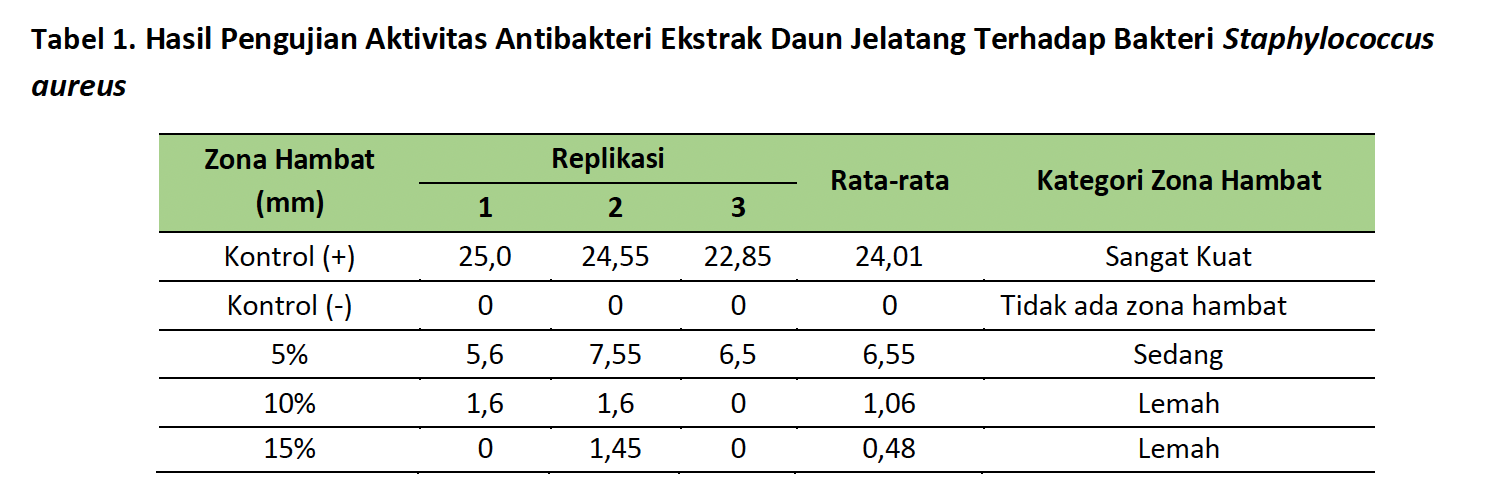
Nettle leaf (Urtica dioica L.) is the most widely known species in the urtica genus and has many benefits for the community, namely for medicine, cosmetics and for consumption. Nettle leaves contain alkaloids, flavonoids, and saponins. These compounds can be known to have antibacterial activity. Staphylococcus aureus bacteria are gram-positive bacteria that can produce a yellow pigment, are facultative aerobes and colonies tend to be shaped like grapes. Naturally Staphylococcus aureus is a normal flora in humans, which is often found on the skin, nose and eyes. This study aims to determine the antibacterial activity of nettle leaf ethanol extract (Urtica dioica L.) against Staphylococcus aureus bacteria . The sample used was nettle leaves (Urtica dioica L.) taken in Buruan Village, Kec. Penebel, Kab. Tabanan. This research was conducted using laboratory experimental methods. The ethanol extract of nettle leaves was prepared by the maceration method using 96% ethanol and the viscous extract was obtained using a rotary evaporator . This study used the disc diffusion method with nutrient agar media. The concentrations of the nettle leaf ethanol extract used were 5%, 10%, and 15%. The antibacterial activity test showed that the ethanol extract of nettle leaves could inhibit the growth of Staphylococcus aureus bacteria at each concentration of nettle leaf extract (Urtica dioica L.) with the following inhibition zone diameters: concentrations of 5% (6.55 mm), 10% (1.06 mm), and 15% (0.48 mm). The nettle leaf ethanol extract had the highest antibacterial activity at a concentration of 5%, namely 6.55 mm, which was included in the medium category.
Keywords : nettle leaf (Urtica dioica L.), antibakterial, Staphylococcus aureus.
References
Villiya DM, Maimunah S. Uji aktivitas antibakteri ekstrak etanol daun jelatang (Urtica dioica L.) terhadap bakteri Escherichia coli. Jurnal Kimia Saintek dan Pendidikan Universitas Sari Mutiara Indonesia. 2021;V(1):23–33.
[2] Trisia A, Philyria R, Toemon AN. Antibacterial activity test of ethanol extract from kalanduyung leaf (Guazuma ulmifolia Lam.) on Staphylococcus aureus growth with diffusion method (Kirby-Bauer). Anterior Journal. 2018;17(2):136–43. Available from: http://journal.umpalangkaraya.ac.id/index.php/anterior/article/view/12/9
[3] Pertiwi FD, Rezaldi F, Puspitasari R. Uji aktivitas antibakteri ekstrak etanol bunga telang (Clitoria ternatea L.) terhadap bakteri Staphylococcus epidermidis. Biosaintropis (Bioscience-Tropic). 2022;7(2):57–68. doi:10.33474/e-jbst.v7i2.471.
[4] Safitri OM, Amir H. Potensi sitotoksik dan antibakteri ekstrak daun Laportea interrupta (L.) Chew (jelatang ayam) terhadap Staphylococcus aureus. Jurnal ... 2018;2(2):175–83.
[5] Ulviani F, Yusriadi Y, Khaerati K. Pengaruh gel ekstrak daun sirih merah (Piper crocatum Ruiz & Pav) terhadap penyembuhan luka bakar pada kelinci (Oryctolagus cuniculus). Jurnal Farmasi Galenika (Galenika Journal of Pharmacy). 2016;2(2):103–10.doi:10.22487/j24428744.2016.v2.i2.5977.
[6] Azizah M, Lingga LS, Rikmasari Y. Uji aktivitas antibakteri kombinasi ekstrak etanol daun seledri (Apium graveolens L.) dan madu hutan terhadap beberapa bakteri penyebab penyakit kulit. Jurnal Penelitian Sains. 2020;22(1):37. doi:10.56064/jps.v22i1.547.
[7] Surjowardojo P, Susilawati TE, Sirait GR. Daya hambat dekok kulit apel manalagi (Malus sylvestrs Mill.) terhadap pertumbuhan Staphylococcus aureus dan Pseudomonas sp. penyebab mastitis pada sapi perah. TERNAK TROPIKA Journal of Tropical Animal Production. 2015;16(2):40-8.
Downloads
Published
Issue
Section
License
Copyright (c) 2023 Ni Komang Esti Trisna Putri, I Wayan Surya Rahadi, Ni Made Sukma Sanjiwani

This work is licensed under a Creative Commons Attribution-NonCommercial 4.0 International License.